Tate St Ives: Tickets, Opening Hours, Exhibitions & Visitor Guide
There’s something quietly magnetic about a national gallery perched on a Cornish beach, and above Porthmeor Beach, Tate St Ives has been pulling visitors since 1993 with a mix of modernist masterpieces and Atlantic views. This guide cuts through the travel chatter to give you the facts on tickets, opening hours, exhibitions, and the real pros and cons of visiting.
Location: Porthmeor Beach, St Ives, Cornwall ·
Year opened: 1993 (original), 2017 (extension) ·
Collection focus: Modern British art with St Ives connection ·
Notable artists: Barbara Hepworth, Patrick Heron, Naum Gabo, Marlow Moss ·
Admission: £14–£15.50 for adults (free for under 18s and locals with pass) ·
Visitor rating: 4.5/5 on TripAdvisor (2024)
Quick snapshot
- Opened in 1993 (Art Fund (UK arts charity))
- Major extension completed in 2017 (Tate St Ives (official gallery website))
- Overlooks Porthmeor Beach (Tate St Ives)
- Part of the Tate network (Wikipedia (established encyclopedia))
- Admission prices may change — verify on the official site before visiting
- Currently displayed artworks rotate regularly — check Tate St Ives What’s On
- Seasonal opening hours vary from year to year — consult Tate FAQ
- 1993: Tate St Ives opens to the public (Art Fund)
- 2017: £8.2m extension by Jamie Fobert Architects adds gallery and education spaces (Jamie Fobert Architects (award-winning firm))
- November 2025: Galleries switch to Tuesday–Sunday 10:00–16:20 (Tate (official FAQ))
- Book tickets online in advance during peak season to guarantee entry (Tate St Ives)
- Check the exhibitions calendar before visiting — seasonal shows run May to October
- Combine with Barbara Hepworth Museum (same complex) for a fuller day (Tate St Ives)
The gallery’s core facts stack up neatly: seven key data points, one pattern — small institution, big ambition.
| Detail | Information |
|---|---|
| Established | 1993 |
| Location | Porthmeor Beach, St Ives, TR26 1TG |
| Collection focus | Modern British art, St Ives School |
| Notable artists | Barbara Hepworth, Patrick Heron, Naum Gabo, Marlow Moss |
| Admission | £14–£15.50 (adults); free for under‑18s, Members, and local pass holders |
| Contact | +44 1736 796226 (Tate St Ives) |
| Website | tate.org.uk/visit/tate-st-ives |
Is it worth visiting Tate St Ives?
What makes Tate St Ives unique?
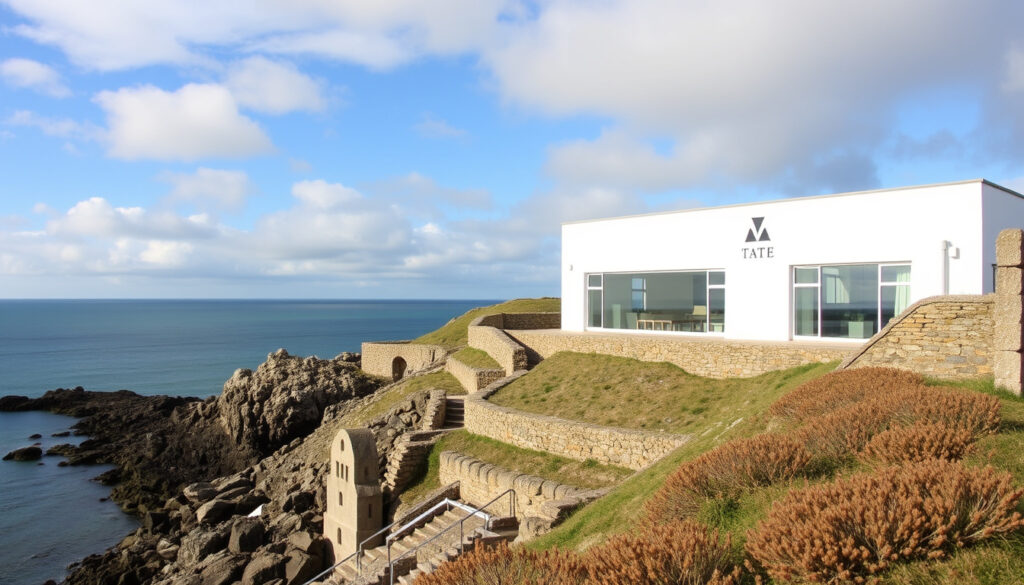
- It sits directly on Porthmeor Beach with floor-to-ceiling windows overlooking the Atlantic Ocean (Tate St Ives (official gallery website))
- The building itself is a landmark — a curved white facade designed by Eldred Evans and David Shalev, later extended by Jamie Fobert Architects (RIBA (Royal Institute of British Architects))
- It focuses on modern British artists who lived and worked in or near St Ives, forming what became known as the St Ives School (Wikipedia – St Ives School)
- Seasonal exhibitions change every few months, often mixing historic works with contemporary commissions (Tate St Ives – What’s On)
For a small gallery in a remote corner of England, Tate St Ives punches far above its square footage — precisely because the setting and the art are inseparable. The light that drew modernist painters a century ago still fills the galleries today.
How long should I spend at Tate St Ives?
Most visitors allocate 1 to 2 hours for the gallery itself, according to on-site guidance and travel reviews on TripAdvisor (user-reviewed travel platform). The permanent collection is compact; the temporary shows add another 30–45 minutes. If you add the café and the shop, budget at least 90 minutes.
The implication: this isn’t an all-day museum. It works best as part of a St Ives day — beach, galleries, harbour, and a pasty.
Pros and cons of visiting Tate St Ives
Upsides
- World-class modernist art in an extraordinary coastal setting
- Free for under‑18s and Cornwall residents with a local pass (Tate St Ives)
- Well-designed extension by Jamie Fobert Architects adds spacious galleries and education rooms (Jamie Fobert Architects)
- Combines easily with Barbara Hepworth Museum and Sculpture Garden (a 5‑minute walk away)
Downsides
- Permanent collection is relatively small compared to other Tate galleries
- Peak season crowds can make the experience feel rushed
- Admission is not cheap for adults (£14–£15.50) without concessions
- Limited parking in St Ives — expect to park in the town car parks and walk up hill
The trade-off: you get intimacy and views that bigger galleries can’t match, but you trade curatorial breadth for them. If you want a full day of art, combine it with the Barbara Hepworth Museum and the Penlee House Gallery in Penzance.
Is the Tate in St Ives free?
Admission prices and ticket options
No — Tate St Ives charges admission for most adults. According to the Tate St Ives booking page (official government-funded gallery), standard adult tickets are £15.50 with donation (Gift Aid) or £14 without donation. Concessions (over 60s, students, disabled visitors) are £14.50 / £13. Children under 18 get in free.
Free entry for locals with a pass
- Cornwall residents can apply for a free Tate St Ives Local Pass, which grants unlimited free entry to the gallery for themselves and up to four children
- National Art Pass holders also get 50% off admission (Art Fund (UK arts charity))
- Tate Members skip the queue entirely — no ticket needed (Tate – Frequently Asked Questions)
Do you need to book in advance?
Tate recommends booking online, especially from May to September. Same‑day tickets are available if space remains, but the ticket desks close 45 minutes before the galleries close (Tate FAQ). The catch: during school holidays and half‑terms, walk‑up slots can sell out by midday.
Why is there a Tate in St Ives?
The St Ives School of artists
Starting in the 1920s and accelerating in the 1940s, St Ives became a magnet for modernist artists fleeing war‑torn Europe and seeking the intense coastal light of Cornwall. The group included Barbara Hepworth, Naum Gabo, Patrick Heron, and Marlow Moss — names now central to 20th‑century British art (Wikipedia – St Ives School). Their work is the backbone of Tate St Ives’ permanent collection.
Barbara Hepworth’s legacy
Hepworth lived and worked in St Ives from 1949 until her death in 1975. Her studio and sculpture garden, now the Barbara Hepworth Museum and Sculpture Garden, are run by Tate and located a short walk from the main gallery. The museum opened in 1976 and became a Tate site in 1980, five years before the idea of a dedicated Tate gallery in St Ives was even proposed.
Development from small gallery to national institution
- 1993: Tate St Ives opens, built on the site of a former gas works on Porthmeor Beach (BBC News – Cornwall)
- 2015–2017: A £8.2 million extension by Jamie Fobert Architects (award‑winning firm) adds a 1,320 m² contemporary gallery, education spaces, and a new entrance
- Today: Part of the four‑museum Tate network alongside Tate Modern, Tate Britain, and Tate Liverpool, but the only one with a seafront address
A national art gallery landed in a fishing town because the town had already become an artists’ colony. The gallery didn’t create the scene — it institutionalised it. That’s why Tate St Ives feels less like a city museum and more like a community shrine to modernism.
The implication: the gallery’s roots in the artists’ colony give it a distinct identity that sets it apart from other Tate galleries.
What can you see at Tate St Ives?
Permanent collection highlights
The gallery does not display a fixed permanent hang — works rotate due to conservation and borrowing agreements. But the core always includes pieces by Barbara Hepworth (bronze and stone sculptures), Patrick Heron (bold, abstract colour‑field paintings), Naum Gabo (Constructivist sculptures), and Marlow Moss (geometric abstractions). The Tate collection online (curated national collection database) lists more than 300 works with St Ives connections.
Rotating exhibitions
Tate St Ives runs two to three temporary exhibitions per year, typically from May to October plus a winter show. Recent examples include Haegue Yang: Leap Year (2023) and Shirin Neshat: Land of Dreams (2022). Check the Tate St Ives What’s On page for current dates.
The building and architecture
The original 1993 building by Eldred Evans and David Shalev features a distinctive curved white facade and a series of galleries that step down the cliffside. The 2017 extension by Jamie Fobert Architects added a double‑height gallery with glazed walls facing the sea. The Guardian (UK newspaper of record) called the extension “a masterclass in how to add to a much‑loved building without spoiling it.”
The pattern: every architectural addition respects the original while enhancing the visitor experience.
What’s the best time to visit Tate St Ives?
Seasonal considerations
- Summer (May–September): Peak tourism season. Book tickets weeks in advance. Galleries open 10:00–17:20 Monday–Sunday.
- Winter (November–February): Fewer visitors, but galleries close earlier (10:00–16:20 Tuesday–Sunday) (Art Fund)
- Shoulder months (March, April, October): Balanced crowds, usually 10:00–17:20, but check the official site for exact dates
Weekdays vs weekends
Tuesday and Wednesday mornings are consistently the quietest slots, according to visitor reports on TripAdvisor (user‑generated travel reviews). Saturdays and school holidays can see queues forming before opening.
Avoiding peak tourist crowds
Arrive right at opening time (10:00) or after 15:00. The café hits peak lunch rush around 12:30–14:00. If you have a car, note that St Ives car parks fill by 10:30 in summer — consider taking the St Ives Park & Ride from the A30 junction (Cornwall Council – St Ives Park & Ride).
The pattern: early birds get the best light and the shortest queues. A winter visit might mean trading a shorter day for an almost private-viewing experience.
What’s confirmed — and what’s still unclear
Confirmed facts
- Tate St Ives opened in 1993 (Art Fund)
- A major extension was completed in 2017 (Tate St Ives)
- The gallery overlooks Porthmeor Beach (Tate St Ives)
- It is part of the national Tate network (Wikipedia)
- Under‑18s enter free (Tate St Ives)
- Cornwall residents can get a free Local Pass
What’s unclear
- Admission prices may change without notice — always check the official site before you go
- The exact list of works on display rotates; don’t book solely for a specific piece
- Seasonal opening hours vary year to year — the November 2025 switch to 16:20 closing is confirmed, but future winter hours may differ
The implication: while many facts are solid, visitors should always verify details before setting out.
What others say about Tate St Ives
Overlooking the Atlantic Ocean, Tate St Ives showcases work by artists including Barbara Hepworth, Marlow Moss, Naum Gabo and Patrick Heron.
— Tate St Ives (official gallery website)
[The gallery] exhibits work by modern British artists with links to the St Ives area.
— Wikipedia – Tate St Ives (collaborative encyclopedia)
[The 2017 extension is] a 1320msq addition that includes a large contemporary gallery, education spaces, transition spaces and offices.
— Jamie Fobert Architects (award-winning practice)
Plan your visit
Tate St Ives is a compact, high‑quality gallery that rewards those who come with realistic expectations. It’s not a blockbuster museum — it’s a curated conversation between art and a very specific place. For a family with under‑18s, the free entry makes it a bargain. For art lovers, the Hepworth connection and the rotating exhibition programme justify the ticket price. For anyone else, the real draw is that view: standing inside a white cube, looking out at the Atlantic through the same light that inspired a generation of modernists.
For visitors from outside Cornwall, the choice is clear: make it part of a day that includes the Barbara Hepworth Museum and a walk on Porthmeor Beach, or skip it if you’re only interested in blockbuster collections. For locals, the free pass is an open invitation to drop in anytime — and you should.
Related reading: Drayton Manor Theme Park Guide: Rides, Tickets & Tips · All Points East 2026: Lineup, Tickets & Tyler the Creator
tate.org.uk, bestdaysoutcornwall.co.uk, ukfront.co.uk, tripadvisor.com, cornwall365.com, instagram.com, xn--c1acbmbpt6aza.com
Visitors planning a trip can find everything they need in the Tate St Ives visitor guide, which covers tickets, hours, and current exhibitions.
Frequently asked questions
Can you just walk into the Tate?
Yes — you can buy tickets at the door, but booking online in advance is strongly recommended, especially during peak season (May–September). Members and Local Pass holders walk straight in (Tate FAQ).
Which is nicer, Newquay or St Ives?
That depends. Newquay has broader beaches and a livelier nightlife; St Ives offers smaller coves, a working harbour, and a world‑class art scene centred on Tate St Ives. For art and culture, St Ives wins.
Is there parking near Tate St Ives?
Limited on‑street parking. The closest pay‑and‑display car parks are St Ives Station car park and the Island car park. In summer, use the St Ives Park & Ride (Cornwall Council service).
How long does a typical visit take?
1–2 hours for the gallery. Add 30 minutes for the café and shop, and up to 1.5 hours for the Barbara Hepworth Museum if you combine them.
Does Tate St Ives have a café or restaurant?
Yes, the site includes a café serving hot drinks, cakes, sandwiches, and light meals. It has large windows overlooking Porthmeor Beach.
Are dogs allowed inside the gallery?
Only assistance dogs are permitted inside the galleries. Well‑behaved dogs are welcome in the café and on the outdoor terrace.
Is photography permitted inside Tate St Ives?
Yes, for personal use only. No flash, no tripods, and no photography in temporary exhibitions where signs indicate otherwise.
More related posts
 Ella Rutherford: Age, Net Worth, and Portsmouth Move
 Sophia Bush: Biography, Relationships, Voice, and Net Worth
 Ashton Kutcher: Health Diagnosis, Relationships, Net Worth
 Nina Drama: Biography, Career, and Relationship Facts
 Where the Heart Is – Plot, Cast and Streaming Guide
 Pete Sampras: Wimbledon Titles, Retirement, and Legacy
 How Do Antibiotics Work – Targeting Bacterial Cell Walls
 Kobe Bryant Helicopter Crash: Full Story & Aftermath