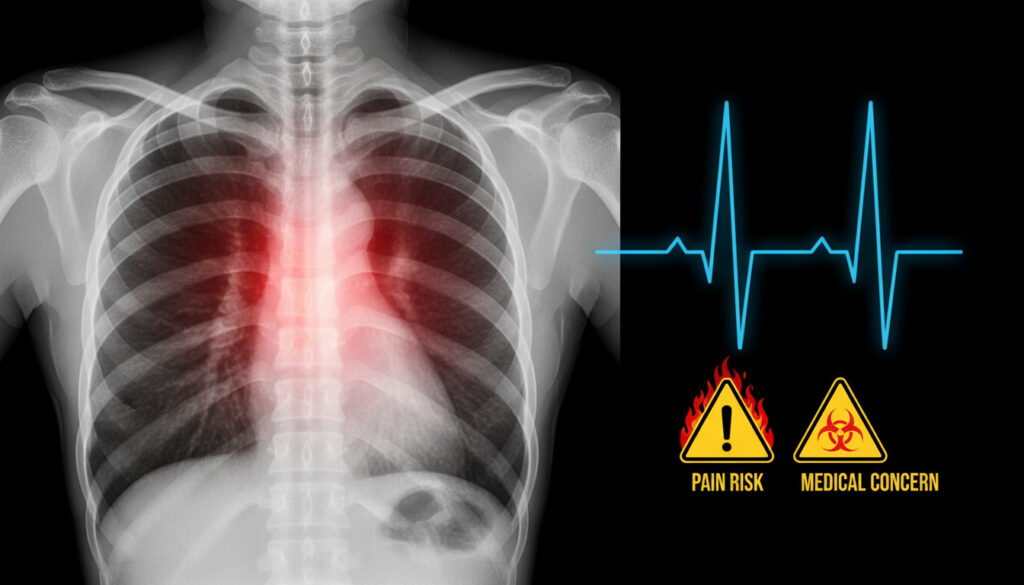
Female Pain in Middle of Chest – Causes, Risks and When to Worry
Middle chest pain in women demands careful clinical evaluation. While cardiac causes account for only a small proportion of chest pain cases overall, the risk varies dramatically based on age and underlying health factors. Understanding these variables helps distinguish between benign conditions and life-threatening emergencies.
A 25-year-old healthy woman experiencing chest pain faces an infinitesimal likelihood of cardiac disease, whereas a 60-year-old woman with smoking history, high blood pressure, elevated cholesterol, diabetes, or family history of heart disease warrants immediate emergency evaluation according to Harvard Health.
What Causes Pain in the Middle of the Chest in Women?
Cardiac Causes
Angina, microvascular dysfunction, and coronary vasospasm. Risk increases significantly after age 50.
GI Issues
GERD affects 20-60% of non-cardiac cases. Esophageal spasms and acid reflux refer pain to the chest center.
Musculoskeletal
Costochondritis, muscle strain, and rib injuries cause sharp, localized pain worsening with movement.
Anxiety/Panic
Psychological conditions produce chest pain mimicking cardiac events, often with rapid heartbeat and sweating.
- Cardiac causes represent a minority of chest pain cases in women overall, but age and comorbidities drastically alter probability
- GERD affects between 20% and 60% of patients diagnosed with non-cardiac chest pain
- Women experience unique cardiac conditions including microvascular dysfunction and impaired coronary relaxation not seen in typical male presentations
- Costochondritis inflammation frequently mimics heart attack symptoms, particularly on the left side
- Anxiety disorders and panic attacks commonly manifest with chest pain indistinguishable from cardiac origins without testing
- Pulmonary embolism requires urgent evaluation, particularly following surgery, prolonged immobilization, or in pregnancy
- Central sensitization of spinal cord neurons contributes to heightened pain sensitivity in functional chest pain disorders
| Symptom Pattern | Likely Cause | Urgency Level | Recommended Action |
|---|---|---|---|
| Squeezing pressure, heaviness, tightness; may radiate to arm or jaw | Angina/Heart attack | High | ER immediately |
| Burning sensation with heartburn or regurgitation | GERD | Low | GI evaluation |
| Sharp, localized pain worsening with pressure or deep breathing | Costochondritis | Low | Primary care/Rest |
| Sudden sharp pain worsening with inspiration, possible cough/fever | Pleurisy/Pneumonia | Medium-High | Urgent care |
| Accompanied by panic, sweating, feelings of impending doom | Anxiety/Panic disorder | Medium | Mental health/Primary care |
| Tenderness to touch, recent physical exertion or injury | Muscle strain | Low | Rest/OTC analgesics |
| Risk factors: surgery, immobilization, pregnancy, hormonal contraceptives | Pulmonary embolism | High | ER with D-dimer |
What Are Non-Heart Causes of Middle Chest Pain in Women?
Non-cardiac sources dominate the differential diagnosis for middle chest pain in women. These conditions range from gastrointestinal reflux to musculoskeletal inflammation and psychological disorders, each requiring distinct management approaches.
Can Anxiety Cause Middle Chest Pain in Women?
Anxiety and panic attacks produce chest pain that closely resembles cardiac pain. Episodes typically feature rapid heartbeat, sweating, shortness of breath, and overwhelming feelings of impending doom according to Cardiac Care PC. Psychological conditions including panic disorder, anxiety, and depression appear frequently in non-cardiac chest pain populations and significantly modulate disease severity perception.
Central sensitization—increased excitability of spinal cord neurons—contributes to visceral and somatic pain hypersensitivity in these patients research published in PMC indicates.
Is GERD Causing My Middle Chest Pain?
Gastroesophageal reflux disease (GERD) stands as the leading non-cardiac cause of middle chest pain. Between 20% and 60% of patients with non-cardiac chest pain suffer from acid reflux according to the American College of Gastroenterology. The pain occurs because the body refers esophageal pain to the center of the chest Michigan Medicine explains.
Patients typically experience heartburn or regurgitation alongside chest discomfort. Other esophageal issues include muscle spasms, high-pressure squeezing of esophageal muscles, and achalasia. Many patients exhibit esophageal hypersensitivity, where nerves register discomfort with minimal acid exposure or pressure changes—a condition sometimes labeled “functional chest pain” Cleveland Clinic notes.
GERD accounts for the majority of non-cardiac chest pain cases in women. If you experience burning sensations accompanied by regurgitation, particularly after meals or when lying down, gastrointestinal causes should be evaluated before assuming cardiac origins.
What Is Costochondritis Chest Pain?
Costochondritis—inflammation of the cartilage connecting ribs to the breastbone—typically presents on the left side and worsens with pressure, coughing, or deep breathing GoHealth UC reports. This presentation easily mimics heart attack symptoms, creating significant diagnostic confusion.
Is Middle Chest Pain Serious in Women?
The seriousness of middle chest pain depends heavily on cardiovascular risk profiles. While most cases in younger women prove benign, specific red flags demand immediate intervention.
When Should a Woman Go to the ER for Chest Pain?
Immediate emergency evaluation becomes necessary for women with cardiac risk factors including age over 50, smoking, high blood pressure, high cholesterol, diabetes, or family history of heart disease.
Symptoms suggesting pulmonary embolism—particularly following surgery, recent trauma, prolonged immobilization, during pregnancy, or in women using hormonal contraceptives—warrant urgent assessment, especially with elevated D-dimer blood tests. Red flags requiring emergency assessment include aortic dissection and pericarditis, though these occur less frequently.
Seek immediate care if chest pain presents as squeezing pressure radiating to the arm or jaw, occurs with severe shortness of breath, or if you have cardiovascular risk factors and are over age 50.
How Is Chest Pain Different in Women vs. Men?
Women frequently present with chest pain resulting from impaired blood flow without traditional coronary artery blockages Yale New Haven Health specialists report. Sex-specific conditions significantly more common in women include microvascular dysfunction affecting small vessels, coronary vasospasm, and impaired relaxation of coronary arteries.
These conditions require specific diagnostic tests and sex-specific treatment approaches distinct from standard protocols developed primarily for male patients. hospital services guide facilities increasingly recognize the necessity of gender-tailored cardiac evaluation protocols.
Women experience unique cardiac pathologies including microvascular angina and coronary vasospastic disorders that standard angiography may miss, requiring specialized stress testing and endothelial function assessment.
How Should Women Respond to Chest Pain Episodes?
- Immediate Assessment: Check for red flags—squeezing pressure, radiation to arm/jaw, severe shortness of breath, or loss of consciousness. If present, call emergency services immediately.
- Risk Stratification: Consider age and risk factors. Women under 30 without comorbidities face low cardiac risk; those over 50 with diabetes, smoking, or family history face high risk.
- Initial Triage: For non-urgent cases, schedule primary care or cardiology evaluation within 24-48 hours for new-onset symptoms.
- Diagnostic Workup: Expect ECG, troponin blood tests, stress testing, or coronary CT angiography based on risk profile. Women may require specialized testing for microvascular dysfunction.
- Treatment Initiation: Management varies by cause—anti-inflammatories for musculoskeletal pain, proton pump inhibitors for GERD, cognitive behavioral therapy for anxiety, or cardiology referral for ischemic causes.
What Is Certain About Female Chest Pain?
| Established Medical Facts | Uncertain or Variable |
|---|---|
| GERD causes 20-60% of non-cardiac chest pain cases in women | Exact threshold for emergency evaluation in low-risk young women without traditional symptoms |
| Women experience sex-specific cardiac conditions including microvascular dysfunction and coronary vasospasm | Precise mechanisms driving esophageal hypersensitivity in functional chest pain |
| Costochondritis produces sharp, localized pain worsening with movement or palpation | Why some women experience ischemic symptoms without detectable coronary obstruction |
| Cardiac risk increases significantly after age 50 with comorbidities like diabetes and hypertension | Optimal screening protocols for microvascular angina in premenopausal women |
| Central sensitization contributes to pain hypersensitivity in functional disorders | Individual variation in pain referral patterns from esophagus to chest wall |
Why Gender Matters in Cardiac Evaluation
Historical medical research predominantly studied male patients, creating diagnostic frameworks that miss female-specific cardiac presentations. Women more frequently experience atypical symptoms and non-obstructive coronary artery disease (INOCA), requiring updated clinical approaches.
Hormonal fluctuations, smaller coronary vessel diameter, and autonomic nervous system differences contribute to unique pain patterns. The recovery tips for health issues approach extends to cardiac rehabilitation, where women often require different pacing and support structures than men following cardiac events.
What Do Medical Authorities Say About Women’s Chest Pain?
Leading medical institutions emphasize that cardiac causes account for only a small proportion of chest pain in women overall, though individual risk varies dramatically. Harvard Health specifically notes the infinitesimal likelihood of cardiac disease in healthy 25-year-old women compared to high-risk older populations.
The Mayo Clinic characterizes cardiac chest pain as squeezing, pressure, heaviness, or tightness—descriptions distinct from the sharp, localized pain of musculoskeletal origins. Meanwhile, Yale New Haven Health specialists confirm that many women have chest pain with impaired blood flow without traditional blockages, necessitating specialized diagnostic protocols.
What Should Women Remember About Middle Chest Pain?
Middle chest pain in women spans a spectrum from benign GERD and musculoskeletal strain to life-threatening cardiac events. While cardiac causes remain statistically uncommon in young healthy women, age over 50 combined with diabetes, smoking, hypertension, or family history demands immediate evaluation. Non-cardiac causes—particularly GERD affecting 20-60% of cases, anxiety disorders, and costochondritis—require distinct treatments ranging from acid suppression to physical therapy and psychological support. Accurate diagnosis hinges on recognizing gender-specific cardiac conditions like microvascular dysfunction and obtaining appropriate specialized testing when standard evaluations prove inconclusive. Consult the hospital services guide for regional cardiac evaluation resources.
Frequently Asked Questions
What does heart-related chest pain feel like in women?
Cardiac chest pain typically presents as squeezing, pressure, heaviness, or tightness in the central chest, potentially radiating to the arm, jaw, or back. Women may also experience atypical symptoms including nausea, fatigue, or shortness of breath without classic chest pressure.
How can I relieve non-serious chest pain at home?
For musculoskeletal pain, rest and anti-inflammatory medications typically provide relief. GERD-related discomfort responds to avoiding trigger foods, eating smaller meals, and elevating the head during sleep. Anxiety-induced pain improves with stress management techniques and psychological support.
What is the difference between heartburn and heart attack chest pain?
Heartburn typically causes a burning sensation with acid regurgitation, often after meals or when lying down. Heart attack pain feels like squeezing pressure or heaviness, may radiate to the arm or jaw, and occurs with exertion or stress. When uncertain, seek emergency evaluation.
Why does anxiety cause chest pain?
Anxiety triggers the release of stress hormones causing rapid heartbeat, muscle tension, and hyperventilation. Central sensitization increases spinal cord neuron excitability, amplifying pain signals. The resulting chest tightness and discomfort mimic cardiac symptoms, creating a cycle of fear and physical sensation.
What tests diagnose chest pain in women?
Initial evaluation includes ECG and blood troponin levels. Women may require specialized testing for microvascular dysfunction, including stress echocardiography, coronary reactivity testing, or cardiac MRI, particularly when standard angiography shows no blockages but symptoms persist.
More related posts
 Europa Conference League Standings – 2025/26 Table and Results
 Shelley Duvall Dies at 75: Cause of Death, Career, and Legacy
 Rampage Jackson: Record, UFC Lawsuit, and Streaming Career
 Maeve Courtier-Lilley – Welsh Actress Movies TV Shows
 Lawrence Shankland: Rangers Transfer, Wedding & Scotland Career
 Forrest Gump: Real Story, Disability, Meaning, and More
 Emily Rudd: Biography, Family, Roles, and FAQs
 Cardiff City vs Newport County: Head-to-Head & Preview