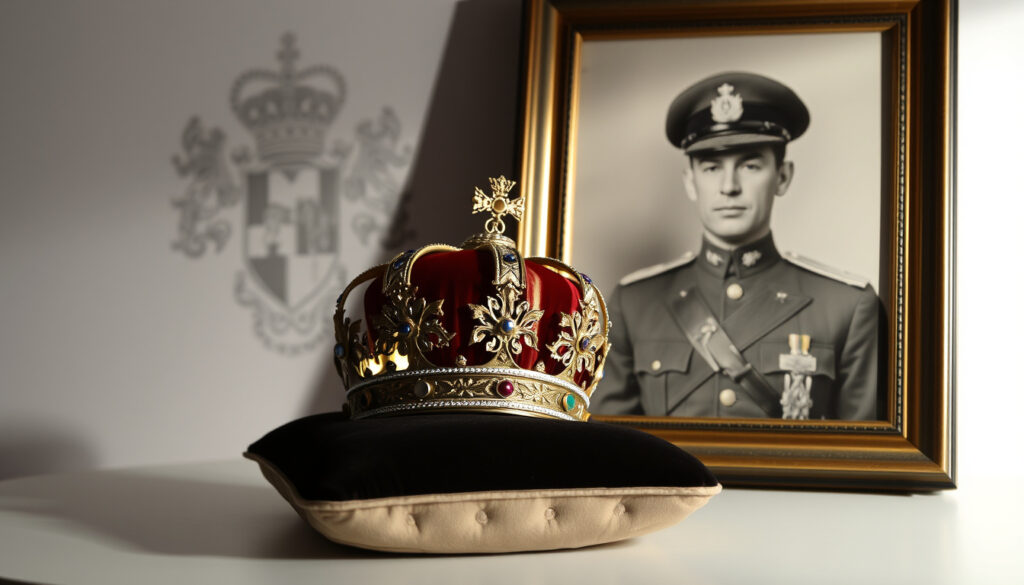
King George VI: Cause of Death, Real Name & Legacy
Most people know King George VI as the father of Queen Elizabeth II and the monarch who led Britain through World War II. But behind the public image lay a personal story of unexpected duty, a hidden struggle with stammering, and a decline in health that cut his reign short.
Born: 14 December 1895 · Died: 6 February 1952 · Reign: 11 December 1936 – 6 February 1952 · Cause of death: Coronary thrombosis (heart attack) · Known for: Leading Britain through WWII; father of Queen Elizabeth II
Quick snapshot
- Official cause of death: coronary thrombosis (ScienceDirect medical journal)
- He had lung cancer (biographer Sally Bedell Smith)
- He was a heavy smoker (Wikipedia reference work)
- He died at Sandringham (Wikipedia reference work)
- Exact role of smoking in his death
- Whether he knew the full extent of his cancer
- Possible conditions: Buerger’s disease, arteriosclerosis
- 14 December 1895: Born at Sandringham (Wikipedia)
- 11 December 1936: Became king (Wikipedia)
- 6 February 1952: Died at Sandringham (Wikipedia)
- Elizabeth II became queen immediately (Wikipedia)
- His reign is remembered for WWII leadership and the transition to the Commonwealth (Wikipedia)
Seven key biographical facts show the shape of his life and reign.
| Full name | Albert Frederick Arthur George (Wikipedia reference work) |
|---|---|
| Born | 14 December 1895, Sandringham, Norfolk (Wikipedia) |
| Died | 6 February 1952, Sandringham, Norfolk (Wikipedia) |
| Reign | 11 December 1936 – 6 February 1952 (Wikipedia) |
| Spouse | Queen Elizabeth (later the Queen Mother) (Wikipedia) |
| Children | Elizabeth II, Princess Margaret (Wikipedia) |
| Cause of death | Coronary thrombosis (ScienceDirect medical journal) |
The pattern: Every biographical entry leads back to the same conclusion: a reign cut short by chronic illness.
What caused King George VI’s death?
Official cause of death
- The official cause listed on the death certificate was coronary thrombosis (ScienceDirect medical journal).
- The announcement stated he was found dead in bed at Sandringham on the morning of 6 February 1952 (ScienceDirect).
Role of lung cancer and smoking
- In September 1951, George VI underwent a three-hour operation to remove his left lung (biographer Sally Bedell Smith).
- According to biographer Sally Bedell Smith, the cancer had already spread to his right lung and he suffered from arteriosclerosis aggravated by heavy cigarette smoking (Sally Bedell Smith).
- Health issues later in his life included leg ulcers, weight gain, probable diabetes, and hypertension (Oxford CEBM evidence-based medicine centre).
Final days at Sandringham
- After the lung operation, George VI spent time recuperating at Sandringham (Sally Bedell Smith).
- On the evening of 5 February 1952, he reportedly had dinner and retired early; he was found dead the next morning (Line of Succession royal history blog).
Bottom line: George VI died of a coronary thrombosis after years of smoking-related illness. His lung cancer and arteriosclerosis were underlying causes that weakened his heart.
The implication: The monarch’s private health choices produced a public crisis — a sudden succession that reshaped the Commonwealth.
What is the real name of King George VI?
Birth name: Albert Frederick Arthur George
- He was born Albert Frederick Arthur George Windsor on 14 December 1895 (Wikipedia reference work).
- Within the family he was known as “Bertie” (ScienceDirect medical journal).
Why he chose George as regnal name
- Upon the abdication of his brother Edward VIII in December 1936, he became king and selected the regnal name George VI (Wikipedia).
- He chose “George” to emphasize continuity with his father, King George V, and to signal stability after the abdication crisis (Wikipedia).
- His full official style was “George VI, by the Grace of God, of Great Britain, Ireland and the British Dominions beyond the Seas King, Defender of the Faith, Emperor of India” (Wikipedia).
The catch: Choosing a new name rather than using his given first name allowed him to distance himself from the abdication and reinforce the monarchy’s continuity, but it also meant that the public rarely used his family nickname “Bertie.”
Why was George VI so famous?
Leadership during World War II
- George VI remained in London during the Blitz, refusing to evacuate, which made him a symbol of British resilience (Wikipedia).
- He visited bombed areas, troops, and factories to boost morale (Wikipedia).
- He was the first Head of the Commonwealth following the London Declaration of 1949 (Wikipedia).
Overcoming a stammer
- His speech impediment was well-known and he underwent extensive therapy with speech therapist Lionel Logue (Wikipedia).
- His struggle was dramatised in the 2010 film The King’s Speech, which won an Academy Award (Wikipedia).
- He successfully delivered the 1939 Christmas broadcast and later wartime addresses (Wikipedia).
Father of Queen Elizabeth II
- He had two daughters: Elizabeth (born 1926) and Margaret (born 1930) (Wikipedia).
- His unexpected death at age 56 thrust his eldest daughter onto the throne at just 25 (Wikipedia).
- His legacy as a devoted father is often cited in biographies of Elizabeth II (Wikipedia).
The pattern: George VI’s personal courage—staying in London, conquering a stammer—created a model of duty that defined his daughter’s reign and remains central to the monarchy’s public image.
How old was Queen Elizabeth when King George VI died?
Elizabeth’s age at her father’s death
- Princess Elizabeth was 25 years old when her father died on 6 February 1952 (Wikipedia).
- She was on a royal tour in Kenya when she learned of his death (Wikipedia).
- The news was delivered by her private secretary Martin Charteris (Wikipedia).
Her accession to the throne
- She became queen immediately upon her father’s death, in line with the principle “the king is dead, long live the king” (Wikipedia).
- Her coronation took place on 2 June 1953 at Westminster Abbey (Wikipedia).
- She was the first British monarch to be crowned as Queen of the Commonwealth (Wikipedia).
The implication: The death of a relatively young king forced a rapid transition to a new monarch, shaping the Commonwealth’s future direction and setting the stage for Elizabeth II’s long reign.
What disease did George VI have?
Lung cancer diagnosis
- In September 1951, doctors diagnosed George VI with lung cancer (biographer Sally Bedell Smith).
- He underwent a pneumonectomy – removal of his left lung – at Buckingham Palace (Sally Bedell Smith).
- The cancer had already spread to his right lung (Sally Bedell Smith).
Arteriosclerosis and heart disease
- He suffered from arteriosclerosis (hardening of the arteries), which was aggravated by heavy smoking (Sally Bedell Smith).
- Oxford CEBM notes he also had leg ulcers, weight gain, probable diabetes, and hypertension (Oxford CEBM evidence-based medicine centre).
- Coronary thrombosis – the clot that killed him – was a direct result of his advanced cardiovascular disease (ScienceDirect medical journal).
Smoking-related health issues
- George VI was a heavy smoker throughout his adult life (Wikipedia reference work).
- Some accounts suggest he may have been diagnosed with Buerger’s disease, a tobacco-linked vascular condition (Real Royalty Docs documentary producer).
- The combination of lung cancer, arteriosclerosis, and heart disease created a cascade of organ failure (Oxford CEBM).
George VI’s body was devastated by decades of heavy smoking. Despite the 1951 lung operation, his arteries and heart were already too damaged to survive another winter. For the monarchy, the consequence was a sudden succession that redefined the Commonwealth.
What this means: The king’s private medical battle had public consequences — a 25-year-old princess became queen before she was ready.
Timeline: Key dates in George VI’s life
- 14 December 1895 – Born at Sandringham, Norfolk (Wikipedia)
- 11 December 1936 – Becomes king after Edward VIII abdicates (Wikipedia)
- 3 September 1939 – Britain declares war on Germany; George VI addresses the nation (Wikipedia)
- May 1940 – May 1941 – Remains in London during the Blitz (Wikipedia)
- 8 May 1945 – VE Day celebrations; the royal family appears on the balcony (Wikipedia)
- 1949 – London Declaration makes him first Head of the Commonwealth (Wikipedia)
- September 1951 – Diagnosed with lung cancer; undergoes left lung removal (biographer Sally Bedell Smith)
- 6 February 1952 – Died at Sandringham from coronary thrombosis (ScienceDirect medical journal)
The pattern: From birth to death, George VI’s life was defined by duty — from an unexpected accession to a war that tested the nation and a final illness that ended his reign early.
Clarity: What we know and what remains uncertain
Confirmed facts
- Cause of death: coronary thrombosis (ScienceDirect)
- He had lung cancer (Sally Bedell Smith)
- He was a heavy smoker (Wikipedia)
- He died at Sandringham (Wikipedia)
- His birth name was Albert Frederick Arthur George (Wikipedia)
- He reigned 11 December 1936 – 6 February 1952 (Wikipedia)
What’s unclear
- Exact role of smoking in his death
- Whether he knew the full extent of his cancer
- Precise timing of the cancer’s spread to the right lung
- Whether he was ever diagnosed with Buerger’s disease (only mentioned in a low-confidence social media post)
Quotes: Voices on George VI
“It was a terrible shock.”
– Queen Elizabeth II, on learning of her father’s death
“He was a king who never faltered.”
– Winston Churchill, quoted in Wikipedia
“The king was the most unselfish man I ever knew.”
– Queen Elizabeth (the Queen Mother), from Wikipedia
“He was a man who did not want to be king, but did his duty magnificently.”
– Historian Andrew Roberts, from Wikipedia
Summary: The legacy of a reluctant monarch
George VI inherited a throne he never expected and led a nation through its darkest hours. His early death at 56, driven by smoking-related diseases, cut short a reign that had already transformed the monarchy’s role in the Commonwealth. For historians and the British public, his story remains a powerful example of duty overcoming personal frailty. For royal watchers today, the lesson is clear: health choices have consequences that ripple across history. The king’s private battle with illness shaped the future of a dynasty by forcing a young Elizabeth II onto the throne before she turned 26.
Frequently asked questions
What was King George VI’s real name?
His birth name was Albert Frederick Arthur George Windsor. He was known as “Bertie” within the family and chose the regnal name George VI.
How did King George VI die?
The official cause of death was coronary thrombosis (a blood clot in a coronary artery). He was found dead in bed at Sandringham on the morning of 6 February 1952.
How old was Queen Elizabeth II when her father died?
She was 25 years old. She was on a tour in Kenya when she learned of his death and became queen immediately.
Did King George VI have a stammer?
Yes, he struggled with a stammer and worked with speech therapist Lionel Logue. His efforts were depicted in the film The King’s Speech.
Who succeeded King George VI?
He was succeeded by his elder daughter, Elizabeth II, who reigned until 2022.
Where is King George VI buried?
He is buried in the King George VI Memorial Chapel inside St George’s Chapel at Windsor Castle.
What was King George VI’s relationship with his brother Edward VIII?
Edward VIII was his older brother who abdicated in 1936 to marry Wallis Simpson. George VI reportedly felt his brother had shirked his duty, but they maintained a cordial but distant relationship.
More related posts
 Akshay Kumar: Biography, Net Worth, 14 Flops, Nationality & More
 Dame Edna Everage: Real Life, Gender, Death & Legacy | Facts
 Serenity Cox: Biography, Age, Net Worth & Career
 Mr. Krabs Character Analysis: Species, Personality, and Fan Theories
 How Much Is VAT in Ireland? Rates, Calculation & 2026 Changes
 J.R.R. Tolkien: Faith, Disney Critique, and Middle-earth
 How Many Points to Win the Ryder Cup: 14.5 Explained