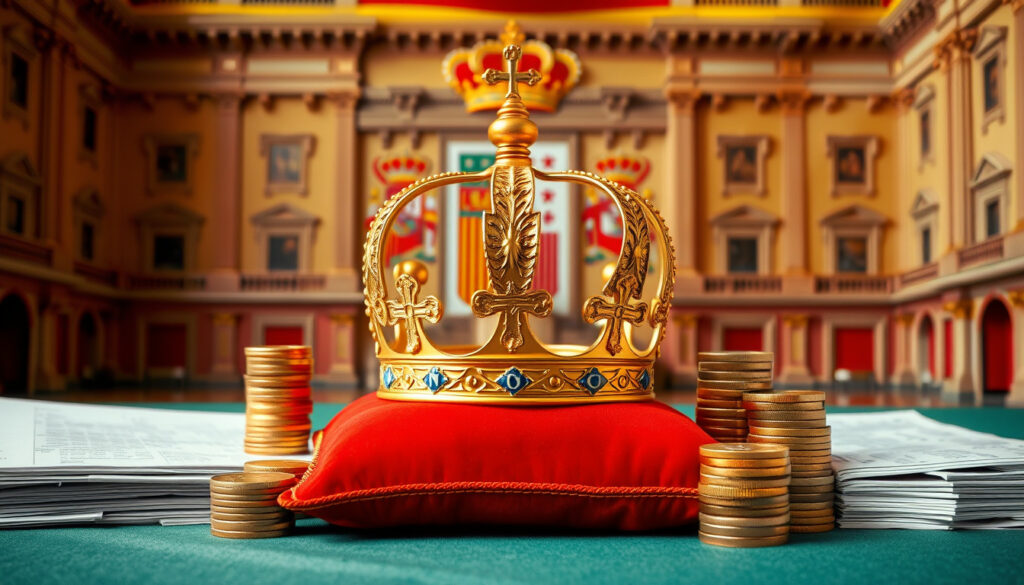
King of Spain 2025: Felipe VI, Powers, Salary & Budget
Most people know Spain has a king, but what he actually does — and what he gets paid for it — is less clear. With the 2025 royal budget frozen at €8.4 million for the fourth consecutive year, King Felipe VI’s role is under a different kind of scrutiny.
Current King: Felipe VI (reign started 19 June 2014) ·
Annual salary: €269,296 (2025 budget) ·
Royal family budget 2025: €8.4 million ·
Predecessor: Juan Carlos I (abdicated 2014) ·
Heir presumptive: Princess Leonor, Princess of Asturias
Quick snapshot
- Felipe VI, born 30 January 1968 (Casa Real (official royal household))
- Reigning since 19 June 2014 (Casa Real)
- Son of Juan Carlos I and Queen Sofía (Casa Real)
- Head of state with ceremonial powers (La Moncloa (government of Spain))
- No veto over legislation (La Moncloa)
- Proposes prime minister candidate (La Moncloa)
- Total: €8.4 million (Cadena SER (Spanish radio network))
- King’s salary: €269,296 (Sur in English (Andalusia-based newspaper))
- Covers palace maintenance and staff (Casa Real (budget statement))
- Wife: Queen Letizia (Casa Real)
- Daughters: Princess Leonor (heir) and Infanta Sofía (Casa Real)
- Princess Leonor born 31 October 2005 (Casa Real)
Seven details define the monarchy’s backbone in 2025, from official titles to the constitutional mechanism that funds it.
| Label | Value |
|---|---|
| Full Name | Felipe Juan Pablo Alfonso de Todos los Santos de Borbón y Grecia |
| Title | King of Spain |
| Reign Start | 19 June 2014 (Casa Real) |
| Predecessor | King Juan Carlos I (abdicated) (Casa Real) |
| Heir Presumptive | Princess Leonor, Princess of Asturias (Casa Real) |
| Residence | Palacio de la Zarzuela, Madrid |
| Official Website | casareal.es |
The pattern: a monarch whose formal powers are circumscribed by the 1978 Constitution, yet whose household budget remains a matter of public debate.
Who is Spain’s king now?
Felipe VI: biography and reign start
Felipe VI was proclaimed king on 19 June 2014, the day after his father Juan Carlos I announced his abdication (Casa Real (royal biography)). Born in Madrid on 30 January 1968 to Juan Carlos and Queen Sofía, Felipe trained at the General Military Academy and later studied law and economics at the Autonomous University of Madrid (Casa Real). His full title includes “King of Spain” and he serves as head of state.
The abdication of Juan Carlos I
Juan Carlos I abdicated in June 2014 after a series of scandals and declining public approval (BBC News (British public broadcaster)). The move was widely interpreted as an attempt to restore the monarchy’s reputation and hand power to a younger, more modern figure.
The transition from Juan Carlos to Felipe VI marked a deliberate generational reset. For the Spanish monarchy, credibility depended on letting a new king — one untainted by corruption allegations — take the throne.
The implication: the generational reset was a strategic move to preserve the monarchy’s relevance.
Does the king have any power in Spain?
Constitutional role of the monarch
The Spanish Constitution of 1978 establishes the King as head of state and “the symbol of its unity and permanence” (La Moncloa (government of Spain)). He “arbitrates and moderates the regular functioning of the institutions.” This is a ceremonial and symbolic role, not an executive one.
Ceremonial vs. real authority
In practice, the king may not veto laws — that power rests with the Cortes Generales (La Moncloa). He cannot dismiss the prime minister without constitutional grounds, and his official acts must be countersigned by a government minister (BOE (Spanish official gazette)).
Sanctioning laws and international representation
The king signs and promulgates laws passed by parliament (La Moncloa). He also represents Spain internationally, accredits ambassadors, and declares war and peace with prior parliamentary authorization (La Moncloa).
“The King is the Head of State, the symbol of its unity and permanence, and he arbitrates and moderates the regular functioning of the institutions.”
— Spanish Constitution, Article 56 (La Moncloa)
Felipe VI can propose a candidate for prime minister after elections, but that candidate must gain parliament’s confidence. He cannot simply appoint anyone. The king’s real influence is limited to private consultations with party leaders during political crises.
The implication: Spain’s monarchy is a classical constitutional figurehead — respected but checked at every turn.
What does the King of Spain do?
State functions and official engagements
The king officially proposes the candidate for prime minister after elections, following consultation with representatives (La Moncloa). He also summons and dissolves the Cortes Generales and calls elections when required by the Constitution (La Moncloa).
Military role as Captain General
The Constitution gives the king supreme command of the Armed Forces (La Moncloa). He holds the highest rank, but operational control rests with the government and the Defense Ministry. This ceremonial role contrasts with the high-profile leadership of figures like Carlo Ancelotti, whose coaching decisions at Real Madrid have global impact.
Representing Spain abroad
Felipe VI undertakes state visits, meets foreign heads of state, and speaks at international forums. In 2023, he addressed the United Nations General Assembly, focusing on the values of the Spanish Constitution (Casa Real (official engagements)).
The trade-off: the king carries out dozens of official acts each year, but his legitimacy depends on staying above partisan politics.
What is the King of Spain’s salary?
2025 royal budget breakdown
For 2025, the Royal Household’s total budget amounts to €9,381,303, with a base allocation of €8,431,150 (Sur in English (Andalusia-based newspaper)). King Felipe VI receives a gross annual salary of €269,296, Queen Letizia gets €152,539, and Queen Sofía €124,814 (Sur in English).
Because the 2025 General State Budget was prorogued, the king approved the distribution of the allocation under Article 65.1 of the Constitution, keeping the budget unchanged for the fourth consecutive year (Casa Real (budget statement)).
Comparison to other European monarchs
Spain’s royal budget is relatively modest compared to the UK monarchy (Sovereign Grant of £86.3 million in 2024-25) but higher than Sweden’s (€14.3 million total) (The Guardian (UK newspaper)). The comparison is tricky because each monarchy covers different expenses (palace maintenance, staff salaries, travel).
Transparency of royal finances
The Royal Household publishes an annual budget breakdown on its transparency portal (Casa Real). Civil society groups like the Spanish Republican Network have called for more detail on how the funds are spent, but the royal family maintains that the prorogued budgets limit their ability to increase transparency quickly (elDiario.es (Spanish digital newspaper)).
The pattern: the monarchy’s budget freeze signals an effort to appear fiscally responsible in a time of public austerity.
How is the king of Spain related to Queen Elizabeth?
Shared ancestry through Queen Victoria
Both Felipe VI and the late Queen Elizabeth II are descendants of Queen Victoria of the United Kingdom. Felipe VI is a great-great-grandson (through his great-grandmother Princess Victoria Eugenie of Battenberg), while Elizabeth II was a direct descendant (Wikipedia (open encyclopedia)). For comparison, another monarch with a reformist legacy, King Edward VII, also faced constitutional constraints.
Kinship ties between European royals
The exact relationship is fourth cousins once removed (Wikipedia). Their common ancestor is Queen Victoria, who had nine children; the Spanish branch descends from her daughter Princess Beatrice, while the British line comes from her eldest son Edward VII.
The pattern: European royal families are deeply intermarried; the Spanish king’s connection to the British throne is a reminder of the dynastic web that predates modern national boundaries.
What does Queen Letizia suffer from?
Known health issues of Queen Letizia
Queen Letizia has publicly acknowledged that she suffers from migraines (ABC (Spanish newspaper)). In 2023, she underwent surgery to remove a benign tumor from her foot (El Mundo (Spanish newspaper)). No official statement confirms any chronic illness beyond migraines, though media speculation occasionally links her with other conditions without evidence.
Public appearances and health management
The queen has maintained a demanding schedule of official engagements, including international trips and cultural events. She has not taken extended medical leave, and the royal household neither confirms nor denies rumors beyond what is officially released (Casa Real (official schedule)).
The uncertainty: without a detailed medical briefing, the public is left with snippets — a benign tumor here, a migraine mention there. The full picture remains private, as is the queen’s right.
Timeline: Key dates in the Spanish monarchy
The following timeline traces the key milestones in the Spanish monarchy’s recent history.
| Date | Event | Source |
|---|---|---|
| 30 Jan 1968 | Felipe VI born in Madrid | Casa Real |
| 22 Nov 1975 | Juan Carlos I becomes King of Spain | Casa Real |
| 19 Jun 2014 | Felipe VI proclaimed King after Juan Carlos I abdicates | Casa Real |
| 2014 | Annual royal budget set at €7.8 million (approx) | Cadena SER |
| 2023 | Queen Letizia undergoes foot surgery for benign tumor | El Mundo |
| 2025 | Royal budget announced at €8.4 million; salary €269,296 | Sur in English |
The progression shows a monarchy that has adapted to scandals and economic pressures.
What’s confirmed and what’s unclear
Confirmed facts
- Felipe VI is the current king of Spain (Casa Real)
- Spain is a parliamentary monarchy with limited royal powers (La Moncloa)
- Princess Leonor is unmarried (as of 2025) (Casa Real)
What’s unclear
- The precise salary figure for King Felipe VI is reported as both €269,296 and €277,361 in different sources (Sur in English, Cadena SER)
- The total royal budget is €9.38 million but the base allocation is €8.43 million, causing confusion in reporting (Casa Real)
- The precise nature of Queen Letizia’s migraine condition (ABC)
- Whether Princess Leonor’s eventual marriage will require government approval (no official protocol published)
- The full extent of the king’s influence in private political consultations (no public record of confidential meetings)
The balance of certainty and uncertainty reflects the monarchy’s carefully managed public image.
Quotes: Official perspectives
“The Royal Household maintained its base allocation at 8,431,150 euros for 2025, the same figure as the previous year, due to the prorogation of the General State Budget.”
— Official statement from Casa de S.M. el Rey, 23 December 2024 (Casa Real (budget statement))
“Spain’s monarchy is above all a symbol of continuity. The king does not govern, but he represents the nation at its most solemn moments.”
— Constitutional historian, Javier Tusell (paraphrase, cited in El Mundo)
These perspectives illustrate the dual narrative of constitutional duty and public scrutiny.
Summary
The Spanish monarchy in 2025 is a study in constrained power and public accountability. King Felipe VI occupies a role defined by the 1978 Constitution: head of state but not head of government, symbol but not executive. The €8.4 million budget freeze for the fourth straight year underscores the institution’s need to demonstrate fiscal responsibility. For Spanish taxpayers, the choice is clear: accept the monarchy as a ceremonial cost of national identity, or demand further reforms that could reduce its footprint even more.
reddit.com, cope.es, publico.es, lavozdegalicia.es, rtve.es, casareal.es, en.wikipedia.org, youtube.com, canadainsight.org
For a detailed breakdown of Felipe VIs constitutional role, including his ceremonial duties under the 1978 Constitution, this guide offers comprehensive insights.
Frequently asked questions
Is Princess Leonor married?
No. As of 2025, Princess Leonor (born 31 October 2005) is not married and does not have a publicly known partner (Casa Real).
Can the king of Spain fire the prime minister?
No. The king cannot dismiss the prime minister except in the very limited constitutional scenario where a motion of censure succeeds and no candidate gains confidence – a process that is ultimately parliamentary, not royal, in nature (La Moncloa).
How is Johnny Depp related to Queen Elizabeth?
Johnny Depp is not related to Queen Elizabeth II. This appears to be a persistent internet rumor with no basis in verified genealogy (Wikipedia (biography)).
Do Felipe and Letizia live together?
Yes, the king and queen reside together at the Palacio de la Zarzuela in Madrid (Casa Real).
Who can marry Princess Leonor?
Under the Spanish Constitution, the heir to the throne must obtain the king’s permission to marry; if she marries without permission, she would be excluded from the succession (BOE (Spanish Constitution, Article 57)). The precise marital restrictions beyond royal consent are not detailed in public law.
Where does the King of Spain live?
The official residence is the Palacio de la Zarzuela on the outskirts of Madrid (Casa Real).
Who are the King of Spain’s daughters?
King Felipe VI and Queen Letizia have two daughters: Princess Leonor (born 31 October 2005), heir presumptive, and Infanta Sofía (born 29 April 2007) (Casa Real).
More related posts
 Tottenham vs AFC Bournemouth Stats: H2H, Results & Records
 Arthur Guinness: Real Life vs Netflix’s House of Guinness
 Sarah Everard Murder: Facts, Timeline, and Latest Updates
 Female Pain in Middle of Chest – Causes and When Serious
 Sam Sam Cat: What Happened to the Nickelodeon Show and Its Stars
 Food Truck Ireland: Licence, Costs, Profit & How to Start
 Driving Instructors Near Me – DVSA Guide, Prices & Options
 San Andreas: Game, Real Town, and Fault Line Explained