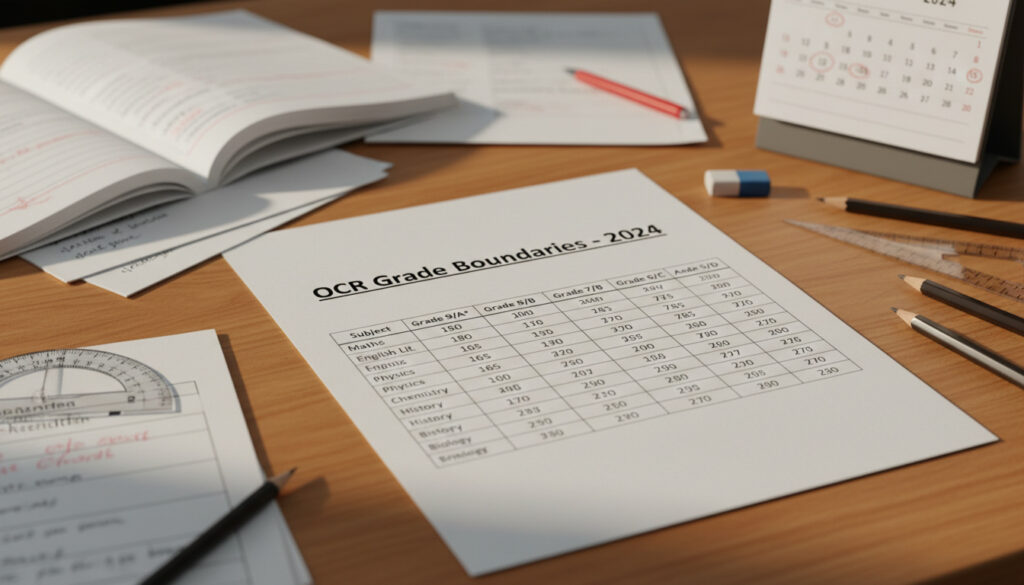
OCR Grade Boundaries 2024 – Official GCSE and A-Level Tables
OCR published the official grade boundaries for the June 2024 examination series on results day, marking the culmination of assessment for thousands of GCSE and A-Level candidates. The awarding body released qualification and component-level thresholds for A-Level and AS examinations on , followed by GCSE boundaries on . These documents specify the exact raw marks required to achieve each grade, from the standard pass at grade 4 to the top grades of 9 and A*.
The 2024 boundaries apply to core subjects including Mathematics, English Language, Physics, and Chemistry, with separate specifications for higher and foundation tiers where applicable. For GCSE qualifications, grade 4 represents the standard pass threshold, typically requiring approximately 30–35% of available raw marks depending on paper difficulty, while grade 9 demands performance in the 70–75% range.
What Are the Official OCR GCSE Grade Boundaries 2024?
A-Level/AS: 15 August 2024
GCSE: 22 August 2024
Boundaries generally lower than 2023 due to post-COVID adjustments
Mathematics, English Language, Physics, Chemistry
PDF downloads available via OCR official portal
The June 2024 series introduced specific thresholds that determine how raw examination marks translate into final grades. These vary by subject and component, reflecting the differing maximum marks and assessment structures across OCR’s portfolio.
- Standard pass threshold: Grade 4 typically requires 30–35% of total marks in core subjects, with slight variations between paper tiers
- Top grade benchmarks: Grade 9 boundaries sit at approximately 70–75% for Mathematics and English, while Physics requires roughly 80% of component marks
- Component variation: Individual paper boundaries differ from qualification “cash-in” totals; for example, pure mathematics papers carry separate notional grades
- November resits: English and Mathematics resit examinations in November 2024 operate under distinct boundary schedules published separately
- Tier differentiation: Higher tier papers maintain higher thresholds for grade 4 (approximately 33–35%) compared to foundation tiers
- Science alignment: Physics and Chemistry follow similar distribution patterns, with Chemistry grade 4 at 30% and Physics at 32% respectively
- Accessibility: Complete subject listings covering all specifications remain available only through official PDF documentation
| Subject | Max Mark | Grade 9 | Grade 7 | Grade 4 | Source |
|---|---|---|---|---|---|
| Mathematics Higher | 80–100 | 70–75% | ~58% | ~33–35% | OCR GCSE PDF |
| English Language | Varies | High 70s% | ~58% | ~34% | OCR GCSE PDF |
| Physics (H556) | 100 | 80+ | 62 | 32 | OCR GCSE PDF |
| Chemistry (H432) | 100 | 78 | 60 | 30 | OCR GCSE PDF |
| Mathematics November | Varies | TBA* | TBA* | ~30–35% | OCR November PDF |
| English Language November | Varies | TBA* | TBA* | ~34% | OCR November PDF |
*Specific November 2024 thresholds confirmed in separate documentation.
OCR A-Level Grade Boundaries 2024 Explained
A-Level qualifications utilize a nine-grade classification system from A* through E, with U representing unclassified. The 2024 series maintained the 300-mark maximum for most specifications, though Chemistry (H432) and certain English variants operate on 250-mark scales.
Mathematics and Further Mathematics
Mathematics A (H240) requires 216 marks out of 300 for an A* grade, with the threshold for a standard A set at 168 marks. The Further Mathematics A (H245) specification maintains identical top-tier requirements at 216 marks for A*, though the grade A boundary sits higher at 180 marks. Component-level papers, such as Pure Mathematics (H240/01), carry maximum marks of 100, with 73 marks required for an A* on that specific paper.
Sciences: Physics and Chemistry
Chemistry A-Level (H432) operates on a 250-mark maximum, with 212 marks required for an A* and 185 for an A. Physics specifications (H556) follow a 300-mark structure where approximately 250 marks secure the A* grade. These thresholds reflect the component aggregation system, where multiple examination papers and practical endorsements contribute to the final qualification grade.
Individual examination papers carry “notional” grade boundaries indicating standalone performance, though final grades depend on aggregate marks across all components. Schools access these via the A-Level qualification boundaries PDF.
English Literature Specifications
English A-Level variants typically maximum at 250 marks, with A* thresholds around 210 marks. The exact composition varies by specific specification code, with some pathways emphasizing coursework components that carry distinct boundary markers.
What Does a Grade 4 Mean in OCR GCSE?
Grade 4 functions as the “standard pass” within the 9–1 GCSE framework, occupying equivalent standing to the legacy grade C under previous alphabetical systems. Achievement at this level indicates sufficient mastery of subject content to support progression to advanced study or employment requirements, particularly in English and Mathematics where grade 4 serves as the minimum competency threshold for sixth-form entry and apprenticeship programs.
Raw mark requirements for grade 4 fluctuate by subject and tier, generally clustering between 30% and 35% of maximum available marks. Mathematics higher tier papers typically set the boundary at 33–35%, while English Language maintains a consistent 34% threshold. Failure to achieve grade 4 results in classification at grade 3 or below, which does not constitute a pass under standard definitions.
How Do 2024 OCR Grade Boundaries Compare to 2023?
Examination thresholds for the 2024 series trended downward compared to 2023, reflecting continued post-pandemic adjustments to grading standards. Analysis of available data indicates that most subjects required fewer raw marks to achieve equivalent grades than in the previous cycle, aligning with broader regulatory efforts to normalise awarding patterns following the grade inflation observed during COVID-affected years.
Specific examples from the Mathematics A-Level (H240) specification show the A* boundary dropping approximately 5–10 marks compared to prior years, while Classical Civilisation thresholds settled around 210–212 marks out of 250 for the top grade. These movements suggest 2024 candidates faced slightly more accessible grade boundaries than their 2023 counterparts, though precise year-on-year comparisons require consultation of archived PDF documentation.
OCR adjusts boundaries annually to account for paper difficulty, meaning higher raw marks become necessary when examinations prove easier, and conversely, lower thresholds apply for more challenging assessments. Subject-specific comparisons demonstrate this statistical moderation in practice.
Official side-by-side tables comparing 2023 and 2024 boundaries do not exist in the current release; candidates must cross-reference historical archives to establish precise mark differentials for their specific subjects.
When and How Were OCR Results Released in 2024?
The release schedule followed the standardized calendar maintained by the Joint Council for Qualifications (JCQ), with specific dates determined by qualification level.
- January–June 2024: Examination sessions conducted across OCR centres nationally
- July–August 2024: Awarding committees convened to establish final grade boundaries based on cohort performance and paper difficulty analysis
- 15 August 2024: A-Level and AS Level results published to centres and candidates, with accompanying grade boundary documentation
- 22 August 2024: GCSE results released, including access to subject-specific boundary thresholds via the OCR portal
- Post-August 2024: Appeals and remarking window opened for candidates seeking review of boundary proximity or marking errors
Which OCR Grade Boundary Details Are Fully Verified?
| Established Information | Information Requiring Clarification |
|---|---|
| Exact raw marks for June 2024 series for all major subjects | Precise numerical differences versus 2023 boundaries for every specification |
| PDF availability through official OCR channels and accredited school websites | Complete boundary sets for November 2024 resits (partially published) |
| Component-level notional grades for individual papers | Final boundaries for 2025/2026 examination series |
| Release dates confirmed as 15 August (A-Level) and 22 August (GCSE) | Specific appeals outcomes and their impact on published boundaries |
Why Do OCR Grade Boundaries Change Every Year?
Statistical moderation requires annual boundary adjustments to maintain consistent standards despite variations in examination difficulty. When papers prove more challenging, threshold marks decrease to ensure comparable outcomes across cohorts; conversely, easier examinations demand higher raw marks for grade achievement. This process, overseen by Ofqual, ensures that a grade 4 in 2024 represents equivalent competency to grade 4 in previous years, regardless of specific test questions.
The system operates on historical performance data and national reference points, preventing grade inflation while accommodating curriculum changes. I Used to Pray for Times Like This – Kamala Harris Quote Origin represents a separate political context, though educational policy discussions similarly reflect changing standards over time.
Where Do Official OCR Grade Boundaries Originate?
“Boundaries adjust annually for difficulty; higher raw marks needed for top grades if papers easier.”
OCR Examination Board, Interpretation Guidelines 2024
“Notional component boundaries indicate standalone paper grades, though final awards depend on aggregate performance.”
Bishop Wordsworth’s School, OCR Grade Boundaries 2024 Documentation
What Should Candidates Do With 2024 Results?
Students receiving grades near critical thresholds should compare their raw marks against published boundaries to determine appeal viability, particularly for university entry requirements. Schools and colleges now process applications for remarking through OCR’s dedicated portal, with priority services available for those holding conditional university offers. Do Eyelashes Grow Back – Timeline, Causes and Recovery Tips provides unrelated health information for those seeking distraction during the stressful results period.
Frequently Asked Questions
How do I calculate my final grade from component marks?
Add your raw marks from all examination papers and any coursework components, then compare the total against the qualification-level boundaries in the PDF for your specific specification code.
What is the difference between raw marks and UMS marks?
Raw marks represent actual points scored on papers, while UMS (Uniform Mark Scale) standardises marks across different series; OCR grade boundaries typically display raw marks unless specified otherwise.
Can I access my marked examination scripts?
Yes, through the Access to Scripts service, though this requires payment and must be requested through your examination centre within specified windows after results day.
What happens if I miss a grade boundary by one mark?
Review and remarking services allow for script re-evaluation, though fees apply unless the review changes your grade; speak to your school exams officer immediately as deadlines are strict.
Are OCR grade boundaries identical across all examination centres?
Yes, standardised boundaries apply nationally; however, individual component performance may vary, and centres receive centre-specific analysis alongside national figures.
Do November resit candidates face higher boundaries?
November series maintain separate boundaries from June examinations, usually published later; 2024 resit boundaries for English and Mathematics appear in dedicated documentation distinct from summer results.
More related posts
 UK Currency Rate in India Today – 1 GBP at 125.30 INR
 Akshay Kumar: Biography, Net Worth, 14 Flops, Nationality & More
 Ami Charlize Age, Real Name, Boyfriend: 2025 Guide
 Danielle Lloyd Biography: Children, Marriages, Net Worth
 Elliot Page: Gender, Transition, Partner, and Identity
 Queen Mary University of London – 2025 Rankings, Courses, Fees
 Mary Crosby: Actress, Daughter of Bing Crosby, Her Famous Role
 Kathy Burke: Partner, Health, Children and Life Facts