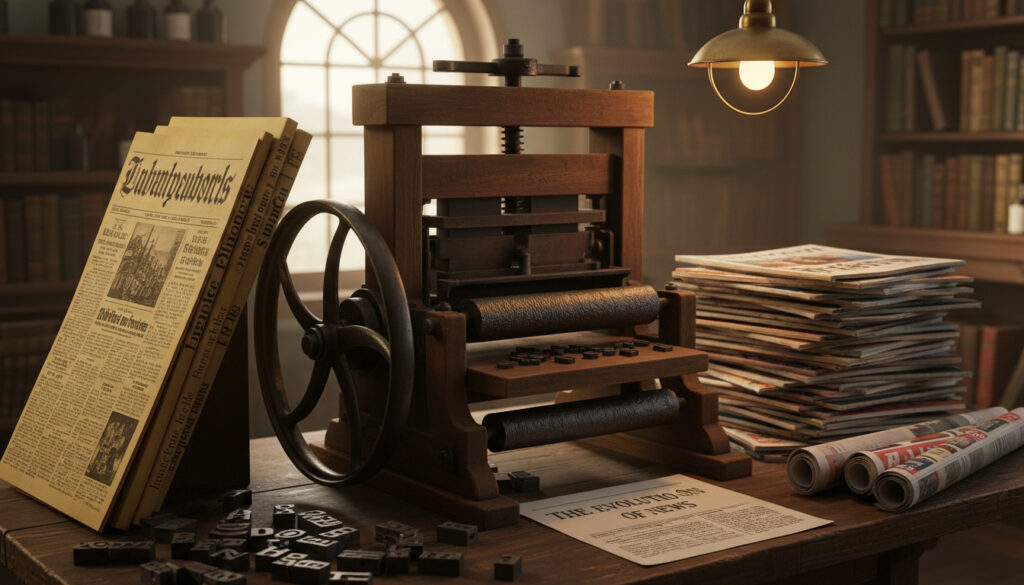
Newspaper – Definition, History, Types and Challenges
A newspaper is a periodical publication that delivers news, views, and information of public interest in regular issues, usually daily or weekly. It generates revenue mainly through subscriptions and advertising, as Britannica outlines.
Traditional coverage includes local and national politics, crime, business, entertainment, and sports. Printed on inexpensive paper, newspapers serve as essential mass media and communication tools.
Tracing back to ancient origins, they remain vital even under modern digital pressures.
What is a newspaper?
| Aspect | Description |
|---|---|
| Publication Type | Periodical with regular issues |
| Revenue Model | Subscriptions and advertising |
| Core Content | Politics, crime, business, entertainment, sports |
| Medium | Printed on inexpensive paper; mass communication |
- Delivers news and public interest information regularly.
- Relies on subscriptions and ads for funding.
- Covers diverse topics like politics and sports.
- Printed affordably for wide access.
- Acts as mass media staple.
- Provides views alongside facts.
| Fact | Details |
|---|---|
| Frequency | Typically daily or weekly |
| Revenue Sources | Subscriptions, advertising |
| Main Topics | Politics, crime, business, entertainment, sports |
| Material | Inexpensive paper |
| Role | Mass communication and media |
| Scope | Local and national |
| Public Interest | News and views |
| Format | Periodical publication |
What types of newspapers are there?
Newspapers differ by format and geographic focus.
Formats
Broadsheets use large pages for serious, in-depth coverage aimed at professional readers, according to Fiveable.
Tabloids favor compact sizes, often focusing on sensational stories and celebrities.
Berliners measure 12.4 by 18.5 inches, bridging tabloids and broadsheets, as Study.com notes.
Berliners offer a middle ground: taller than tabloids, narrower than broadsheets.
Geographic Scope
National dailies cover entire countries.
Metropolitan dailies focus on local and regional news.
Suburban and small-town dailies highlight community stories. See Recognizing Various Types of Newspapers.
What challenges do newspapers face today?
Radio emerged as competition in the 1920s, followed by television in the 1950s.
Digital media now poses ongoing threats to print operations.
Newspapers continue to adapt and persist.
Radio and TV began eroding audiences from the 1920s; digital accelerates the decline.
What are the key milestones in newspaper history?
- 59 BC: Romans launch Acta Diurna, postings of public events on metal or stone (Britannica).
- Mid-1400s: Gutenberg invents the printing press, paving the way for modern newspapers (Fiveable).
- 1566: Handwritten news sheets circulate in Venice. Wikipedia.
- 1605: Johann Carolus publishes Relation aller Fürnemmen und gedenckwürdigen Historien in Germany, the earliest recognized printed newspaper. A brief history of newspapers.
- 1665: London Gazette establishes English design standards (Wikipedia).
- 1702: The Daily Courant becomes the first English daily.
- 1785: The Times founded.
- 1791: The Observer established.
- 1830s: High-speed presses enable mass production worldwide.
By the 1830s, low-cost printing reached Europe, America, Asia, and the Middle East.
What facts about newspapers are established versus unclear?
| Established Facts | Unclear or Debated |
|---|---|
| Definition as periodical media | Precise earliest printed example |
| Core topics: politics to sports | Exact influence of Venice sheets |
| Revenue via ads and subs | Timing of full mass adoption |
| Formats: broadsheet, tabloid | Primary causes of digital shift |
Why do newspapers matter in society?
Newspapers shape public discourse as key mass communication channels.
They inform citizens about critical events, supporting an informed society.
Historically central, they have set enduring standards for journalism.
What sources underpin newspaper knowledge?
Traditional coverage includes politics, crime, business, entertainment, sports.
Reliable references include Britannica, Australia Insight, and academic sites like Study.com.
How can we summarise newspapers?
Newspapers persist as printed periodicals blending news and views. They evolved from ancient notices through printing innovations, now confronting digital rivals, and are classified by format and scope.
What covers a typical newspaper?
Politics, crime, business, entertainment, sports—local and national.
When did newspapers first appear in England?
London Gazette in 1665; first daily The Daily Courant in 1702.
What is a broadsheet?
Large-format paper with serious, in-depth news for professionals.
How did printing presses change newspapers?
Mid-1400s invention enabled 17th-century emergence and 1830s mass production.
What competes with newspapers now?
Radio since 1920s, TV from 1950s, and digital media.
What is the oldest recognised newspaper?
Johann Carolus’s 1605 German publication.
Do newspapers still exist?
Yes, despite digital threats.
More related posts
 April Jones: Case Timeline, Father’s Death & Family Aftermath
 Members of Oasis Band – 2025 Reunion Lineup and Ages
 Simon Neil Biffy Clyro: Age, Wife, Children, Net Worth & More
 Violet Myers: Biography, Career, and Current Activities
 Rodney Bewes: Life, Feud, and Legacy of The Likely Lads Star
 Lahore Qalandars vs Karachi Kings Timeline: Head-to-Head Record
 Off the Shoulder Tops: Flattering Body Types & 2026 Trends
 Jennifer Love Hewitt: Age, Husband, Kids, Movies & TV Shows