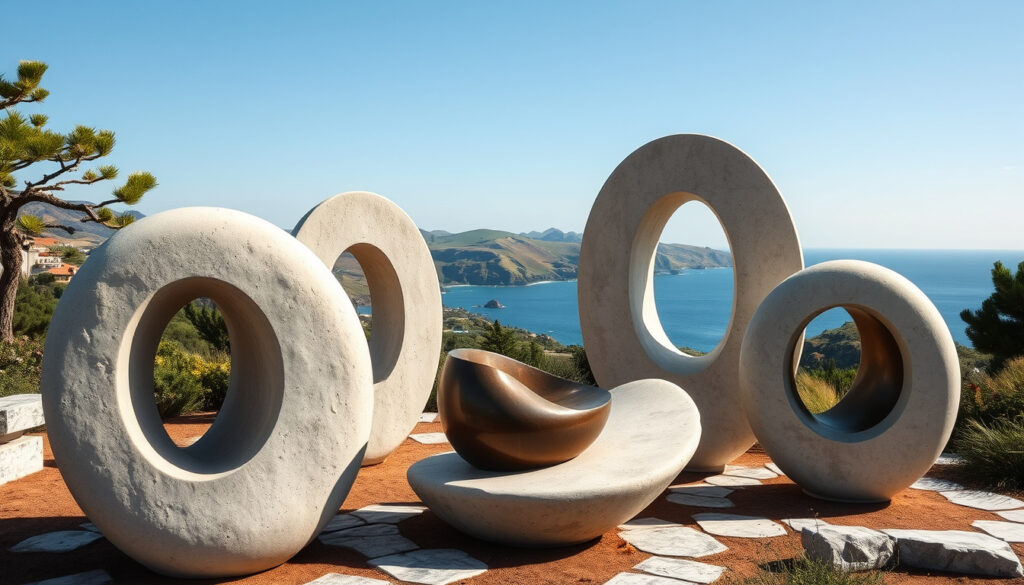
Barbara Hepworth: Life, Sculptures, and Legacy of a Modernist Pioneer
Few sculptors have managed to transform a simple hole into a profound statement about art and space the way Barbara Hepworth did; her work invites you to look at the void not as an absence but as an active, breathing part of the sculpture itself. This guide explores the life of the British modernist, the stories behind her pierced forms, and the legacy she left behind in St Ives.
Born: 10 January 1903, Wakefield, England ·
Died: 20 May 1975, St Ives, England ·
Known For: Modern sculpture with pierced forms and stringed pieces ·
Spouses: 2 (John Skeaping, Ben Nicholson) ·
Children: 4 (one son, triplets) ·
Major Museum: Barbara Hepworth Museum, St Ives; The Hepworth Wakefield
Quick snapshot
- Born in Wakefield in 1903, studied at Leeds School of Art and the Royal College of Art (Tate biography)
- First pierced sculpture created in 1931, ‘Pierced Form’ (The Hepworth Wakefield)
- Died in a fire at her St Ives studio on 20 May 1975 (Britannica)
- Barbara Hepworth Museum and Sculpture Garden preserves her Trewyn Studio (Barbara Hepworth Museum)
- Whether she had a romantic relationship with Henry Moore — no credible evidence exists (Wikipedia)
- Exact circumstances of the fire that took her life remain partly speculative (Britannica)
- Whether she ever used assistants for carving — no detailed records survive (Tate collection)
- Exact number of stringed pieces created between 1939 and 1945 is not formally catalogued (Hepworth Wakefield about)
- 1931 — First pierced sculpture (The Hepworth Wakefield)
- 1939 — Began stringed sculptures (Wikipedia career)
- 1949 — Moved to Trewyn Studio, St Ives (Barbara Hepworth Museum)
- 1968 — Major retrospective at Tate (Tate St Ives)
- 1975 — Death by accidental fire (Britannica death)
- Visit the Barbara Hepworth Museum in St Ives (Tate)
- Explore her works at The Hepworth Wakefield (Hepworth Wakefield explore)
- Understand her influence on modern sculpture (Wikipedia legacy)
Who is Barbara Hepworth?
Dame Jocelyn Barbara Hepworth was a leading figure in 20th-century British sculpture, born in Wakefield, West Yorkshire, on 10 January 1903. Her father, Herbert Hepworth, was a county surveyor and alderman, and her mother, Gertrude, was a homemaker. She was one of four children and grew up in a house that valued education and the arts. She attended Wakefield Girls’ High School before moving on to Leeds School of Art and later the Royal College of Art in London.
Hepworth’s journey to becoming a sculptor was shaped by her early exposure to the landscape of Yorkshire and the coast of Cornwall, where she would later settle. She married John Skeaping in 1932 — a fellow sculptor — but the marriage ended in 1934. She then married artist Ben Nicholson in 1938, with whom she had triplets (one son and two daughters). The family moved to St Ives in 1939, a place that would become central to her artistic identity.
The implication: Hepworth’s personal life, marked by two marriages and the raising of four children, was as complex as the forms she carved into stone.
What is Barbara Hepworth best known for?
Barbara Hepworth is best known for her pioneering use of holes and pierced forms in modern sculpture. Her work from the 1930s onwards — especially pieces like ‘Pierced Form’ (1931) and ‘Single Form’ (1961) — carved space into solid material, creating a dialogue between interior and exterior. She was one of the first sculptors to treat the hole as a structural element, not just a decorative cut.
| Work | Year | Material | Significance |
|---|---|---|---|
| Pierced Form | 1931 | Wood | First sculpture to feature a deliberate hole |
| Single Form | 1961 | Bronze | Commissioned for the United Nations |
| Three Forms | 1935 | Marble | Exploration of abstract organic shapes |
| Sphere with Inner Form | 1952 | Bronze | Celebrated for its polished, reflective surface |
One pattern: four distinct works, one shared obsession with the void. Each piece uses negative space to create tension between what is visible and what is hidden.
Her landmark pieces are permanently displayed at two major sites: the Barbara Hepworth Museum and Sculpture Garden in St Ives and The Hepworth Wakefield in her hometown. The Hepworth Wakefield, which opened in 2011, houses the largest collection of her works in a purpose-built gallery.
The catch: Hepworth’s holes were not about emptiness. They were about making the space inside the sculpture as important as the material outside — a radical idea that reshaped modern sculpture.
Why did Barbara Hepworth put holes in her sculptures?
Hepworth introduced holes to explore the relationship between interior and exterior space, a concept she said was inspired by the landscape around her. She first used a pierced form in 1931 with ‘Pierced Form’, created while she was living in Cornwall. The Cornish coastline — with its caves, cliffs, and eroded rock — became a direct visual reference for the negative spaces in her work.
She described the hole as a way to “create a tension and harmony between the solid mass and the void,” making the sculpture feel as if it were breathing. This idea was revolutionary at a time when most sculptors focused on the fullness of form, not its absence.
The implication: Hepworth’s holes were not just aesthetic choices but philosophical statements about the relationship between human experience and the natural world.
What happened to Barbara Hepworth?
Barbara Hepworth died on 20 May 1975 in a fire at her studio in St Ives. The fire was accidental, caused by a cigarette that ignited a pile of rags. She was 72 years old. The fire destroyed her workspace, but the building was later restored and is now the Barbara Hepworth Museum, run by Tate.
The circumstances of her death have been the subject of some speculation, but the official record from the Tate and local authorities confirms the cause: a heat source, a combustible material, and a moment of inattention. The tragedy of her death is inseparable from the place where she lived — Trewyn Studio, a house that she had made her home and creative centre.
What this means: The fire that killed Hepworth is also the fire that created the museum. Her studio, preserved as it was, gives visitors a direct line into her working life. The line between biography and art is unusually thin here.
What was Barbara Hepworth’s famous quote?
One of her most famous quotes comes from her writings on sculpture: “I do not want to make pretty things; I want to make things that have a life of their own.” Another is her definition of the art form itself: “Sculpture is the art of the hole and the lump.”
Both quotes capture her refusal to make decorative art. She wanted her pieces to function as independent beings, not as ornaments. The second quote — “the art of the hole and the lump” — is a perfect summary of her approach to form. She saw sculpture as a balance between two opposing forces: the solid and the void, the mass and the absence.
“Sculpture is the art of the hole and the lump.”
— Barbara Hepworth
The pattern: Hepworth’s own words are the best guide to her work. She understood her art so clearly that she could explain it in one sentence.
Did Henry Moore have a relationship with Barbara Hepworth?
Barbara Hepworth and Henry Moore were close friends and professional colleagues, but there is no credible evidence of a romantic relationship between them. They met as students at the Royal College of Art and became the two most prominent British sculptors of the 20th century. Their studios were near each other in London, and they shared an interest in abstraction and the human form.
Despite persistent rumours — fuelled by their proximity and the fact that both were married to other artists — no letters, diaries, or accounts from their contemporaries suggest a romantic link. Their relationship was one of mutual respect and artistic influence. Moore himself said of Hepworth: “She was one of the first sculptors to think of the hole as an integral part of the sculpture.”
“She was one of the first sculptors to think of the hole as an integral part of the sculpture.”
— Henry Moore
The trade-off: The rumour is more famous than the truth. But the truth — two artists who shaped each other’s work without a shared bed — is a more interesting story than the one the gossip tells.
For more on British modernists, see L.S. Lowry: Life, Art, and Legacy of the Industrial Painter.
adam-yamey-writes.com, tammytourguide.wordpress.com, kettlesyard.cam.ac.uk, artfund.org, en.wikipedia.org, guggenheim-venice.it, cornishsecrets.co.uk, norskecasinoer.us
Frequently asked questions
How many husbands did Barbara Hepworth have?
She had two husbands: John Skeaping (1932–1934) and Ben Nicholson (1938–1951).
Where can I see Barbara Hepworth’s work in the UK?
The two main sites are the Barbara Hepworth Museum and Sculpture Garden in St Ives (Tate) and The Hepworth Wakefield in Wakefield.
What is the Hepworth Wakefield?
The Hepworth Wakefield is a gallery and museum in Wakefield that holds the largest collection of Barbara Hepworth’s works. It opened in 2011.
What materials did Barbara Hepworth use?
She worked in wood, stone (marble and alabaster), bronze, and later in her career, polished metals.
What awards did Barbara Hepworth receive?
She was appointed CBE in 1958 and DBE in 1965. She also represented Britain at the Venice Biennale in 1952 and 1968.
What is Barbara Hepworth’s most famous sculpture?
‘Single Form’ (1961) is often cited as her most recognisable work, alongside ‘Pierced Form’ (1931) and ‘Sphere with Inner Form’ (1952).
For visitors to St Ives or Wakefield, the choice is clear: see her work in the place where she made it. The Barbara Hepworth Museum in St Ives is a studio preserved in time, while The Hepworth Wakefield is a modern gallery built to house her largest pieces. Both are essential to understanding how a sculptor who spent her life exploring the relationship between form and space could turn a tragedy into a legacy. For practical tips on visiting, see our Tate St Ives Visitor Guide.
More related posts
 Newspaper – Definition, History, Types and Challenges
 Puff Daddy: Real Name, Net Worth, and Legal Charges
 Nipsey Hussle: Life, Death, and Lasting Community Impact
 The Car Buying Group – Reviews, Pricing and Legitimacy
 What Is the Hear Me Out Cake? TikTok Trend & How to Do It
 First Direct Savings Account: 7% Regular Saver vs Competitors
 Peterborough United F.C. – Table Fixtures Results and News
 Cardiff City vs Newport County: Head-to-Head & Preview