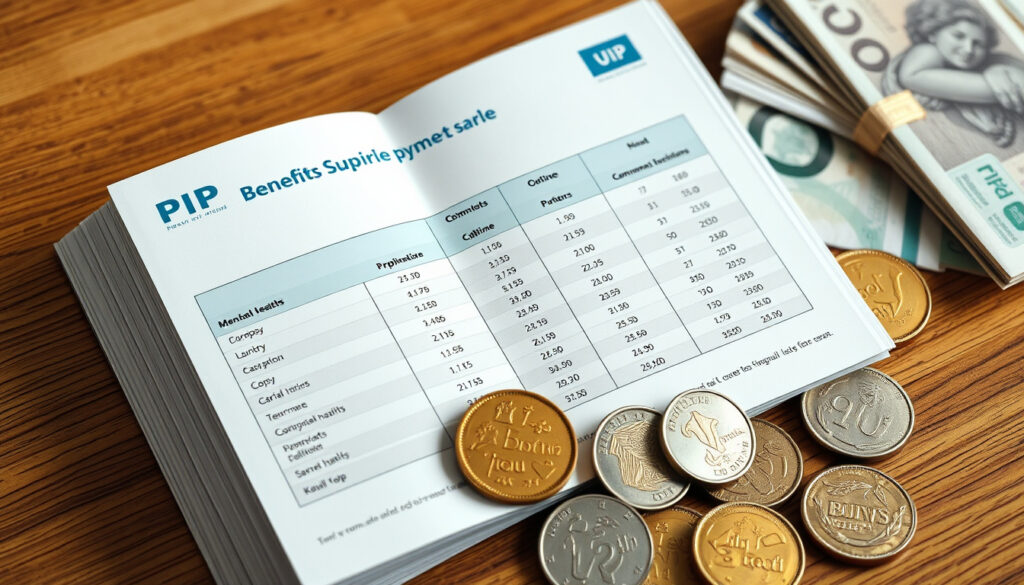
PIP Rates for Mental Health: UK Payments Guide
Psychiatric conditions account for nearly 40% of all PIP awards in England and Wales, and mental health conditions do qualify for Personal Independence Payment. Claimants with depressive disorder now win just over half of all new applications.
Daily living standard rate: £76.70/week · Daily living enhanced rate: £114.60/week · Mobility standard rate: £28.70/week · Mobility enhanced rate: £75.75/week · Depression claim success rate: 51.18%
Quick snapshot
- Depressive disorder claims succeed 51.18% of the time (Benefits and Work)
- Psychiatric disorders make up 39% of all PIP awards (HomeCare.co.uk)
- Daily living standard rate is £76.70 per week (Money Saving Expert)
- Whether 2026 PIP rule changes will tighten eligibility for mental health conditions (Citizens Advice)
- How long individual awards will be granted — this varies case by case (Citizens Advice)
- Latest DWP figures cover October 2024 data, published February 2025 (Benefits and Work)
- 3.7 million people were claiming PIP as of 30 April 2025 (HomeCare.co.uk)
- Government is consulting on PIP reforms that could affect mental health claimants from 2026 onward (Citizens Advice)
- Reassessed claimants win at 79% — significantly higher than the 50% for new psychiatric claims (GOV.UK DWP)
The table below summarises current PIP component rates and key success metrics for mental health claimants.
| Label | Value |
|---|---|
| Standard daily living rate | £76.70/week |
| Enhanced daily living rate | £114.60/week |
| Mobility standard rate | £28.70/week |
| Mobility enhanced rate | £75.75/week |
| Depression claim success rate | 51.18% |
| Overall PIP success average | 53% |
| Psychiatric new claims award rate | 50% |
| Psychiatric reassessed award rate | 79% |
How much does PIP pay for mental health?
PIP splits into two parts — the daily living component and the mobility component — and each has a standard and an enhanced rate. You can claim one, both, or either depending on how your condition affects you. Mental health conditions most often affect daily living, though some claimants also qualify for the mobility component.
Standard and enhanced rates for daily living
- Standard rate: £76.70 per week
- Enhanced rate: £114.60 per week
These figures come from the official DWP schedule and are updated each April in line with inflation. To receive any daily living payment, you need to score at least 8 points across the relevant activity descriptors during your assessment. Enhanced rate requires 12 points or more.
Even if you don’t qualify for the enhanced rate initially, scoring 8 points still unlocks the standard rate — worth £76.70 per week, paid every four weeks as a lump sum of around £307.
Mobility component rates
- Standard rate: £28.70 per week
- Enhanced rate: £75.75 per week
Mobility component claims are less common for pure depression or anxiety, but they become relevant if your mental health condition also affects your ability to plan or make journeys. The enhanced mobility rate can also open doors to schemes like the Motability Scheme, letting you exchange some or all of your mobility payment for a vehicle adaptation or lease.
The implication: claimants awarded enhanced mobility can use those funds to access a car through Motability, making this a financially significant escalation from standard rate.
Can you claim PIP due to mental health?
Yes — mental health conditions including depression, anxiety, and related disorders qualify for PIP, provided they affect your ability to carry out daily activities or get around. The key test is not your diagnosis but how your condition limits you in specific, assessed areas.
Eligibility criteria
You must meet the following baseline requirements to claim PIP:
- Aged between 16 and State Pension age
- UK resident for at least 2 of the last 3 years
- Have a long-term health condition — physical, psychiatric, or both — that affects your daily living or mobility
The DWP records over 500 distinct health condition categories for PIP, and they use clinical terminology. “Depressive disorder” rather than simply “depression” is the term most likely to appear in your records — something worth checking when preparing your application.
Psychiatric disorders make up nearly 40% of all PIP awards, making them the most common condition group among recipients.
Conditions like depression and anxiety
Psychiatric disorders are actually the most common condition group among PIP recipients, representing 39% of all awards. Success rates vary by the specific term used on your claim:
- Depressive disorder: 51.18% success rate
- Anxiety and depressive disorders (mixed): 50.90%
- Generalised anxiety disorder: 43.91%
- Other anxiety disorders: 42.07%
What this means: despite the perception that mental health claims are harder to prove, depressive disorder actually performs slightly above the overall average success rate of 51.63%. Research from PMC NCBI found that patients with severe mental illness had 1.48 times the odds of receiving PIP compared to other psychiatric diagnoses — suggesting that severity and functional impact are what drive approvals.
How do I prove my mental health for PIP?
Building a strong PIP claim for a mental health condition comes down to two things: gathering solid evidence and understanding how the scoring descriptors work. The assessment is not medical — it’s functional. The assessor wants to see how your condition affects everyday tasks, not just a diagnosis on paper.
Evidence needed
- Letters or reports from your GP, psychiatrist, or psychologist
- Details of medications and dosage changes over time
- Records of therapy or counselling sessions
- Hospital admission or crisis episode records if applicable
- Statements from people who know you well — family, friends, carers
The strongest evidence packages tell a consistent story across multiple sources. A psychiatrist’s report that describes specific functional limitations carries more weight than a short letter confirming a diagnosis.
Points system overview
PIP uses 12 daily living activities and 2 mobility activities, each scored from 0 to 12 points depending on how much help you need. You don’t need to show you always need help — the descriptors look at whether you can do something reliably, safely, and in a reasonable time.
Even struggling to initiate tasks like preparing food or managing medication — without always needing physical help — can score points in activities like “Managing therapies” or “Engaging with other people face to face.” Mental health impacts that seem subtle to you may map directly to assessable descriptors.
The pattern: claimants who learn to describe their difficulties in terms the descriptors recognise score significantly higher than those who rely on diagnosis alone.
Is it hard to get PIP for depression and anxiety?
The numbers tell a more encouraging story than the reputation suggests. While rejection rates have been high — over 50% of applications were turned down between 2019 and 2024 — depressive disorder claims now succeed more often than the average. The gap between new claims and reassessed claims is particularly wide.
Success rates
Overall, just 41% of new PIP claims were approved between 2019 and 2024. For psychiatric conditions specifically, the normal rules new claim award rate sits at 50% under the DWP’s May 2020 to April 2025 statistics. However, this figure rises dramatically to 79% for reassessed claims — people who already hold PIP and are having their award reviewed. Psychiatric disorders slightly trail musculoskeletal conditions (55% new claim rate) but fall within a comparable range.
Among the conditions within the psychiatric category, schizoaffective disorder leads at 71.45% success — notably higher than depressive disorder at 51.18%. This suggests that conditions with more readily documented functional severity tend to perform better.
Common challenges
- The 3-month rule: You generally need your condition to have lasted 3 months and be expected to continue for another 9 months. For mental health, this often means documenting a history, not just a recent episode.
- Inconsistency in evidence: If your medical records show periods of stability alongside your claim, the assessor may question the ongoing impact.
- Descriptor matching: Claimants often score points in activities they don’t realise are assessable, or fail to describe their difficulties in terms the descriptors recognise.
Over 50% rejection means most people who apply without preparation face denial. But 51.18% of depressive disorder claims ultimately succeed — meaning a well-evidenced, descriptor-focused application has a strong chance of approval on first attempt.
How long is PIP awarded for mental health?
PIP awards are given for a fixed period — called an award length — after which the DWP reviews your claim. The length of award reflects how predictable your condition’s trajectory is. For mental health conditions, award lengths can vary considerably depending on whether your condition is stable, fluctuating, or expected to improve.
Award periods
Award periods can range from as little as 12 months for a new claimant whose condition is still being understood, up to 5 years or more for someone with a well-documented, long-term mental health condition that is unlikely to change significantly. The DWP is required to tell you the end date of your award and the review date when they write to you.
37% of all PIP claims received the highest level of award as of April 2025, according to official DWP statistics. Psychiatric conditions are well-represented in this group when the functional evidence is thorough.
Review process
Before your award ends, the DWP will write to ask you to confirm your circumstances have not changed, or they will schedule a new assessment. The review assessment tends to be less involved than the initial claim for most claimants. For mental health, if your condition remains largely consistent, the review is an opportunity to reinforce your evidence rather than build it from scratch.
The pattern: reassessed claims win at 79% compared to 50% for new claims. This isn’t because the assessment gets easier — it’s because established claimants have a documented record, and the DWP can see the ongoing functional picture across time rather than at a single point.
Steps to claim PIP for mental health
You can claim PIP for a mental health condition if you meet the eligibility criteria. Each step below walks through how to structure your claim for the best possible outcome.
- Check your eligibility: Confirm you are aged 16 to State Pension age, have lived in the UK for at least 2 of the last 3 years, and your mental health condition affects daily living or mobility. You do not need to have worked or paid National Insurance contributions.
- Request the claim form: Call the DWP PIP claim line or apply online. You will receive a “How your disability affects you” form (PIP 2) with 14 activity questions to complete. Take your time — there is no deadline pressure once the form arrives.
- Collect supporting evidence: Gather letters from your GP, psychiatrist, or therapist covering your diagnosis, treatment history, and specific functional limitations. Request these well in advance, as medical professionals can have waiting times.
- Complete the PIP 2 form with descriptor language: Use the exact wording from the assessment descriptors where possible. Describe your worst days, not your average days. Include concrete examples — “I cannot prepare a meal more than twice a week because I lack motivation and energy” beats “I struggle with cooking.”
- Add a supporting statement: Write a personal account describing how your condition affects you day to day. This is your chance to explain the nuances a medical letter might omit — the bad mornings, the crash days, the tasks you start but cannot finish.
- Submit and wait for the assessment: After submitting your form, you will be invited to a face-to-face assessment. Prepare for this by reviewing your form and knowing your descriptor scores. Take someone with you if possible.
- After the decision: If approved, you will receive a letter with your award amount, component(s), and review date. If rejected, you have one month to request a mandatory reconsideration and, if unsuccessful, to appeal to the Social Security and Child Support Tribunal.
Average decision time for a new PIP claim is around 20 weeks, though this can be shorter or longer depending on local processing times and the volume of claims.
The overall average success rate for PIP claims is 51.63%, but this varies widely depending on your main disabling condition.
— Benefits and Work (benefits guide)
Psychiatric disorders make up almost 40% of awards.
— HomeCare.co.uk (care advice publication)
43% receive an award for normal rules new claims.
— GOV.UK DWP (official statistics)
Related reading: DWP benefits rules · body dysmorphia
Mental health claimants often receive standard daily living payments of £76.70 weekly, in line with the PIP rates 2024 to 2025 that detail annual adjustments and comparisons.
Frequently asked questions
How much is PIP per week?
PIP is paid at two rates per component. Daily living standard is £76.70/week, enhanced is £114.60/week. Mobility standard is £28.70/week, enhanced is £75.75/week. You can receive one or both components at standard, enhanced, or a combination of the two.
How much is PIP per month?
PIP is paid every four weeks in arrears. Receiving the standard daily living rate alone gives you around £307 every four weeks, or roughly £1,228 per month. Enhanced rates or both components significantly increase this amount.
What is the 3 month rule in mental health?
You need your mental health condition to have affected you for at least 3 months before you can claim PIP. You must also expect the effects to continue for at least another 9 months. This is the DWP’s qualifying period — you cannot claim PIP for a short-term mental health episode.
Are PIP payments backdated?
PIP cannot normally be backdated. The claim process starts from the date you contact the DWP to request a form. If you are appealing a decision through mandatory reconsideration or tribunal, you can request a backdate from the appeal date in certain circumstances, but the standard route does not allow backdating.
Can I get a mobility car on standard rate PIP?
Only if you receive the enhanced rate of the mobility component. Standard rate mobility (£28.70/week) does not qualify for the Motability Scheme. If you receive enhanced mobility (£75.75/week), you can exchange that payment to lease a vehicle through Motability.
How much PIP will I get?
Your total depends on which components and rates you qualify for. Standard daily living alone is £76.70/week; enhanced daily living alone is £114.60/week. If you also qualify for enhanced mobility, your maximum combined weekly payment is £190.35.
What PIP freebies and extras are available?
PIP claimants may qualify for additional support including Council Tax discounts, Vehicle Excise Duty exemption, and travel discounts on public transport. Those on enhanced mobility can access the Motability Scheme. Eligibility for these extras is assessed separately and you should check with your local authority and the relevant scheme providers.
What happens if my PIP claim is rejected?
You have one month to request a mandatory reconsideration — where the DWP reviews the decision. If the reconsideration upholds the rejection, you can appeal to the Social Security and Child Support Tribunal. Psychiatric claims rejected at initial assessment have a reasonable reversal rate at mandatory reconsideration stage when additional evidence is submitted.
More related posts
 How Much Potassium in a Banana – Mg, mEq and Comparisons
 One of the Girls Lyrics: The Weeknd, JENNIE & Lily-Rose Depp Full
 Kathy Burke: Partner, Health, Children and Life Facts
 Stevie Nicks: Health, Love Life, and Career Facts
 Things to Do in Berlin: Top Attractions & Budget Tips
 Jey Uso: Biography, Wife, Kids, and Career Highlights
 Martin O’Neill: Religion, Family Health & Managerial Career
 How Many Points to Win the Ryder Cup: 14.5 Explained