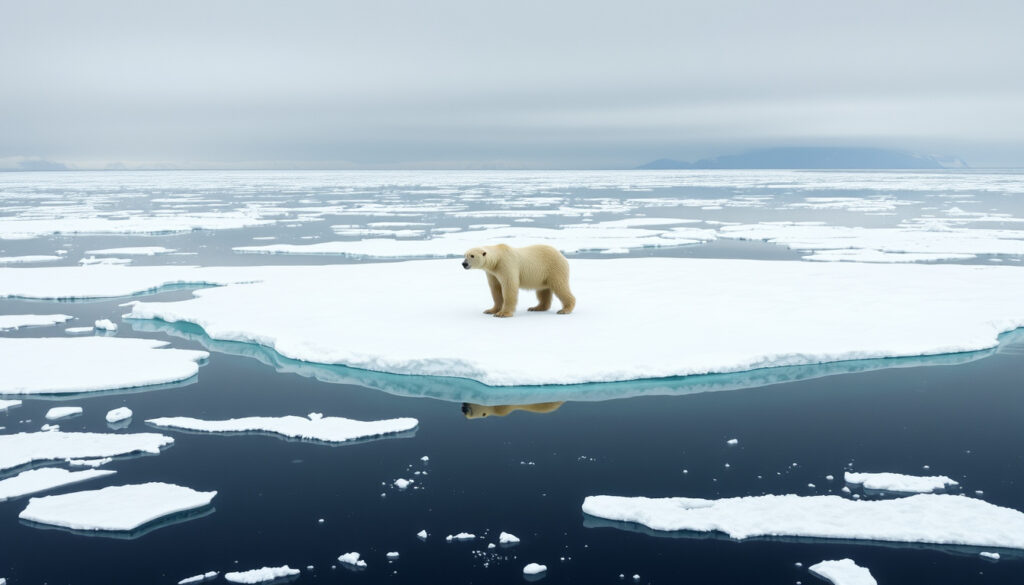
Polar Bears: Facts, Habitat, Threats, and Conservation Guide
There’s a reason polar bears have become the unofficial mascot of the Arctic’s frozen expanse: they are the only bear species classified as a marine mammal. While their fuzzy white appearance might suggest a cuddly cousin of the brown bear, their entire existence revolves around sea ice, where they hunt seals and travel vast distances across the ocean.
Scientific Name: Ursus maritimus ·
Adult Male Weight: 300–800 kg ·
Global Population Estimate: 20,000–30,000 ·
IUCN Red List Status: Vulnerable ·
Primary Habitat: Arctic sea ice
Quick snapshot
- Polar bears are found exclusively in the Arctic (Wikipedia).
- Males weigh up to 800 kg (The Marine Mammal Center).
- Primary prey is ringed and bearded seals (World Wildlife Fund).
- Exact global population count due to remote habitats.
- Long-term impact of earlier sea ice melt on cub survival rates.
- Full extent of hybridization with grizzly bears (pizzly bears).
- Exact population trend for some subpopulations is unknown.
- 2008: U.S. lists polar bear as threatened under the Endangered Species Act (Marine Mammal Commission).
- 2010: U.S. designates critical habitat in Alaska (Marine Mammal Commission).
- 2023: Five-year review maintains threatened status (Marine Mammal Commission).
- Sea-ice decline is projected to reduce polar bear habitat further.
- International cooperation under the 1973 Agreement continues.
- Hybridization with grizzlies may increase as ranges overlap.
Below is a summary of key attributes of polar bears.
| Attribute | Value |
|---|---|
| Scientific Name | Ursus maritimus |
| Lifespan in Wild | 25–30 years |
| Male Weight | 300–800 kg |
| Female Weight | 150–300 kg |
| Top Speed on Land | 40 km/h |
| Swimming Speed | 10 km/h |
| IUCN Status | Vulnerable (IUCN Polar Bear Specialist Group) |
| Estimated Population | 22,000–31,000 |
Are polar bears Arctic or antarctic?
Polar bears are strictly Arctic dwellers. They live only in the northern hemisphere’s frozen ocean and surrounding landmasses — never in Antarctica. Their range includes Canada, Alaska (USA), Greenland, Russia, and Norway’s Svalbard archipelago. Canada alone hosts roughly 60% of the global polar bear population, according to the World Wildlife Fund (Arctic conservation organization).
What country has the most polar bears?
- Canada: home to about 60% of the world’s polar bears (World Wildlife Fund).
- Greenland (Denmark): significant populations along the east and west coasts.
- Norway (Svalbard): a key subpopulation area.
- Russia: the Siberian Arctic hosts several subpopulations.
- United States (Alaska): two subpopulations — Southern Beaufort Sea and Chukchi Sea.
The implication: polar bear conservation requires cross-border collaboration.
What are 5 interesting facts about polar bears?
Eight attributes, one pattern: polar bears are built for extremes. Let’s break down the most surprising details.
- Largest land carnivore: Adult males reach 3 meters in length and weigh up to 800 kg (The Marine Mammal Center).
- Not actually white: Their fur is translucent; it appears white because it scatters visible light (Wikipedia).
- Black skin underneath: The dark skin absorbs solar radiation, helping them stay warm.
- Strong swimmers: They can swim for days at speeds of 10 km/h, covering over 100 km in a single stretch.
- Seal specialists: Ringed seals and bearded seals make up the bulk of their diet (The Marine Mammal Center).
What is a polar bear famous for?
Polar bears are famous for being the only bear species classified as a marine mammal. Their scientific name — Ursus maritimus — translates to “sea bear,” reflecting their reliance on the Arctic Ocean’s sea ice for hunting, breeding, and denning (PMC/peer-reviewed article).
The marine mammal classification isn’t just a label — it triggers legal protections under the U.S. Marine Mammal Protection Act, adding layers of conservation oversight that wouldn’t apply to a purely terrestrial bear.
The catch: the marine mammal classification triggers legal protections.
Are polar bears aggressive?
Polar bears are generally not aggressive toward humans unless they are hungry, surprised, or protecting their cubs. However, as sea ice shrinks due to climate change, bears are forced to spend more time on land, where encounters with people become more likely. According to the IUCN Polar Bear Specialist Group, loss of sea ice is the primary stressor affecting polar bear behavior.
- Most attacks occur when bears are food-stressed or defending cubs.
- They are solitary and typically avoid humans.
- Climate change increases overlap with human settlements.
The more ice melts, the more polar bears wander into towns — making them a climate-change indicator as much as a species.
What this means: as ice melts, conflict risks rise.
What is a polar bear’s worst enemy?
Adult polar bears have no natural predators. But their real enemy isn’t another animal — it’s climate change. The IUCN Polar Bear Specialist Group (global authority on polar bear conservation) identifies sea-ice loss as the top threat. Humans also pose direct risks through hunting and pollution.
What animal is a polar bear afraid of?
Polar bears may retreat from large groups of walruses, which can fight back, and orcas occasionally prey on swimming bears. But these are rare exceptions.
Are polar bears endangered?
Polar bears are listed as Vulnerable on the IUCN Red List. The U.S. classified them as threatened under the Endangered Species Act in 2008, a status reaffirmed in a 2023 five-year review by the Marine Mammal Commission (federal advisory body). According to the WWF, four of the 19 subpopulations are declining, two are increasing, and five are stable.
The implication: conservation efforts must target emissions reductions.
Who would win, hippo or polar bear?
One criteria, one clear verdict: in a hypothetical face-off, a hippo would win. Hippos weigh up to 1,500 kg — roughly double a male polar bear — and possess a bite force of over 1,800 psi. But these animals never meet in the wild. Hippos live in sub-Saharan Africa, polar bears in the Arctic.
| Trait | Polar Bear | Hippo |
|---|---|---|
| Weight | 300–800 kg | 1,000–1,500 kg |
| Length | 2–3 m | 3–5 m |
| Bite Force | ~1,200 psi | ~1,800 psi |
| Habitat | Arctic sea ice | African rivers and lakes |
| Speed on Land | 40 km/h | 30 km/h |
If you’re comparing size and strength, the hippo wins. But the question misses the point: each is the apex predator of its own ecosystem, and they’d never cross paths.
What animal is the king of the Arctic?
The polar bear is widely considered the king of the Arctic. As the region’s apex predator, it sits atop the food chain with no natural enemies among other wildlife (The Marine Mammal Center).
Confirmed facts
- Polar bears live only in the Arctic. (Wikipedia)
- They primarily eat ringed and bearded seals. (World Wildlife Fund)
- Sea ice is critical for hunting and breeding. (IUCN Polar Bear Specialist Group)
- IUCN status is Vulnerable. (IUCN Polar Bear Specialist Group)
What’s unclear
- Exact population numbers due to remote habitats.
- Long-term effects of earlier ice melt on cubs.
- Full hybridization impact with grizzly bears.
- Exact population trend for some subpopulations is unknown.
The pattern: each animal is king in its own domain.
Quotes from experts
“Polar bears are an indicator species. If the sea ice goes, they go. The trajectory is clear: we must reduce greenhouse gas emissions if we want to keep polar bears on the planet.”
— Dr. Steven Amstrup (Chief Scientist, Polar Bears International)
“International cooperation is the only way to protect a species that crosses national borders. The 1973 Agreement on the Conservation of Polar Bears remains a model for how nations can work together.”
— WWF Arctic Programme spokesperson
Summary
Polar bears are not just Arctic icons; they are a living signal of planetary health. For the next decade, the choice for governments and conservationists is clear: enforce the 1973 Agreement and slash emissions, or watch one of the world’s most adapted predators decline as the ice vanishes. For the reader, understanding where they live and why they matter is the first step in supporting policies that keep the Arctic cold.
en.wikipedia.org, goldstarcanada.com, arcticwwf.org, library.arcticportal.org, facebook.com, polarbearsinternational.org, godestad.se
Frequently asked questions
How fast can polar bears swim?
Polar bears swim at about 10 km/h, but they can cover long distances — up to 100 km in a single day — thanks to their powerful front paws.
Do polar bears hibernate?
Only pregnant females enter a denning state over winter. Males and non-pregnant females remain active year-round, though they may reduce activity during severe weather.
Why are polar bears white?
Their fur is actually translucent and appears white because it scatters visible light. The black skin underneath absorbs heat from the sun.
How long can polar bears hold their breath?
Polar bears can hold their breath for up to two minutes while diving underwater, though typical dives are shorter.
What do polar bears eat in the summer?
When sea ice recedes, they may scavenge on whale carcasses, bird eggs, and vegetation, though this diet lacks the high-fat content they need from seals.
Are polar bears friendly to humans?
No. They are wild predators and should be treated with extreme caution. Encounters often end poorly for both parties.
How many polar bears are left in the wild?
Estimates range from 22,000 to 31,000 individuals across 19 subpopulations, according to the IUCN Polar Bear Specialist Group.
Understanding these basics helps in appreciating the challenges polar bears face.
More related posts
 Transit Custom for Sale – UK Used and New Deals
 Where Can I Watch MobLand? Paramount+, Amazon Prime, Apple TV
 Forrest Gump: Real Story, Disability, Meaning, and More
 Kelly Somers: Biography, Career, and Personal Life
 Debby Ryan: What Happened to the Disney Star
 Small Table and Chairs – Best IKEA Sets for Small Spaces
 David Blaine: Net Worth, Stunts, and Current Life in 2025
 Harriet Kemsley: Disability, Husband, and Biography Facts